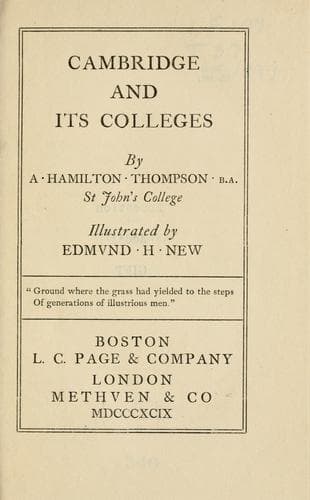
Cambridge and Its CollegesThompson, A. Hamilton (Alexander Hamilton)
History
Cambridge and Its Colleges
Thompson, A. Hamilton (Alexander Hamilton)
University of Cambridge
Before we return to Great St Mary’s, we pass the Decorated church of St
Michael, which was built by Hervé de Staunton in 1337, and served as a
chapel to his foundation of Michael House. It is a fine church, a good
deal modernised, but containing sedilia in the chancel, which are not
unlike those at St Edward’s. The stalls in the choir are very complete,
and are very excellent examples of fifteenth-century woodwork. At the
end of the south aisle is a picture of Charles I. which bears a very
close resemblance to the famous frontispiece of the _Eikon Basilike_.
When Henry VIII. amalgamated the numerous foundations in this quarter
of the town, and founded Trinity College, this church, like Great St
Mary’s, became college property, and the living is still in the gift of
Trinity. In St Michael’s was buried Paul Fagius, the Lutheran Hebraist,
who lectured in Cambridge and died there during the reign of Edward VI.
His bones, however, were exhumed to gratify Queen Mary’s Commissioners
in 1557, and were burned with those of Bucer in the Market Place. This
is one of the few historical facts which we can connect with Cambridge
churches. They are, architecturally speaking, much more interesting than
the churches of many old towns, and people who are weary of the sameness
of the churches crowded together in places like Norwich or Colchester
will turn to these with relief. But their records are barren, and,
although we know a certain amount about Barnwell Priory, we should like
to know more. While of the Templars’ church absolutely no record remains,
and the building merely informs us with a baffling reticence that
Cambridge must at one time, among its religious houses, have numbered a
rich and important Commandery of that glorious but unfortunate Order.
FOOTNOTES
[1] _E.g._ Brancepeth and Sedgefield, Co. Durham.
[2] Merton College was founded in 1264, but its corporate existence does
not actually begin till 1274. Similarly, Peterhouse, founded in 1281, did
not possess buildings or enjoy a common life till 1284, the year of Hugh
de Balsham’s death.
[3] Much of the glass was re-touched in the last century, and some was
added about 1845.
[4] Waynflete had, no doubt, something to say about the building of the
College. He was a great architect, as his work at Tattershall Castle
shows.
[5] The tower may be compared with the palace which Alcock built at Ely.
Both are admirable examples of their style.
[6] With the exception of the range of buildings (1822) forming an
extension of the east side of Cloister Court.
[7] There is a somewhat untrustworthy tradition that Ben Jonson was a
member of the college for a very short time. His means, although aided by
the generosity of a friend, did not allow him to stay at Cambridge. Barry
Cornwall supposed him to have been here or at Trinity.
[8] Professor W. E. Collins, of King’s College, London, the historian,
should, however, be mentioned as an undergraduate and late tutor of
Selwyn.
Public-domain text, read in full here on John Shaqi.
Reviews
Reviews
No reviews yet
Be the first to share your thoughts on this work.
Elsewhere in the archive
Join the Discussion
Join the discussion
Sign in to leave a comment or review.
Sign InorCreate an account