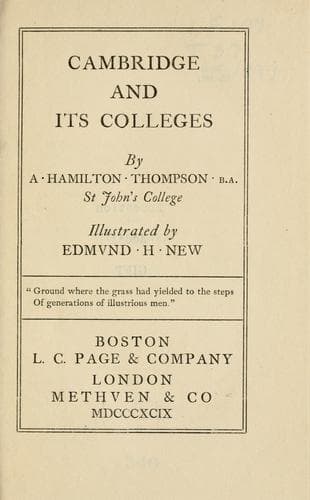
Cambridge and Its CollegesThompson, A. Hamilton (Alexander Hamilton)
History
Cambridge and Its Colleges
Thompson, A. Hamilton (Alexander Hamilton)
University of Cambridge
Penitence, too, moved Henry VII. to finish the chapel. As a member of
the House of Lancaster, his hereditary duty compelled him to complete
a work which even Edward IV. had found pleasure in favouring; while,
as one of the most extortionate and unjust kings who were establishing
their thrones about that time, his conscience invited him to do something
as an _amende honorable_ for his misdeeds. King’s College was already
looked upon as a royal legacy, and all the kings in their turn were well
disposed to it, but none promoted its welfare so much as Henry VII.,
although his benefits were chiefly posthumous. The provost to whom the
task fell of seeing that Henry’s bequests were rightly fulfilled was
Robert Hacombleyn, who also had a reputation in his time as a commentator
on Aristotle. He lies buried in one of the chantries south of the
antechapel. He was succeeded by Edward Fox, a native of Gloucestershire,
who was provost from 1528 to 1538. Fox was a reformer, but it is said of
him that he had “prudence to avoid persecution.” He was essentially a
diplomatist, and held the Bishoprick of Hereford during the last three
years of his provostship. He was busily engaged by Henry VIII. in the
matter of the divorce, and was sent to Clement VII., Stephen Gardiner
being his companion. Afterwards he was ambassador to France and Germany,
and finally to the Schmalkaldic League, when Henry, in his new-fangled
zeal for the Reformation, felt disposed to join that body. At King’s he
was followed by George Day, who filled the office till 1548, and held the
see of Chichester with it.
Henry VIII. was a benefactor to King’s as well as his father. He had
other foundations of his own to look after, however, and seems to
have regarded King’s as a good recruiting-ground for Christ Church at
Oxford—the college whose glory really belongs to Wolsey. Among those
students of Eton and King’s whom we find thus transferred is Robert
Aldrich. Aldrich has not much to do with King’s, but was Master, Fellow,
and finally Provost of Eton, and, after several promotions, became Bishop
of Carlisle, where he remained until 1556, having successfully weathered
all the religious storms of his age. Another very prominent member of the
college was Richard Cox, fellow in 1519. His strong Lutheran opinions
brought him into favour after the divorce. He had been a Canon of
Wolsey’s original Cardinal College; in 1546 he was made Dean of Christ
Church. He was also tutor to Edward VI. As a commissioner at Oxford, he
displayed great fury against the papists, and, at Mary’s accession, not
unnaturally fled to Strasburg, where he had the congenial society of
Peter Martyr Vermigli. As Bishop of Ely from 1559 to 1582, he had time to
modify his opinions, and it is recorded of him that he hated puritans as
much as papists. Queen Elizabeth is said to have disliked him; he must
certainly have been very far from her mind.
Public-domain text, read in full here on John Shaqi.
Reviews
Reviews
No reviews yet
Be the first to share your thoughts on this work.
Join the Discussion
Join the discussion
Sign in to leave a comment or review.
Sign InorCreate an account