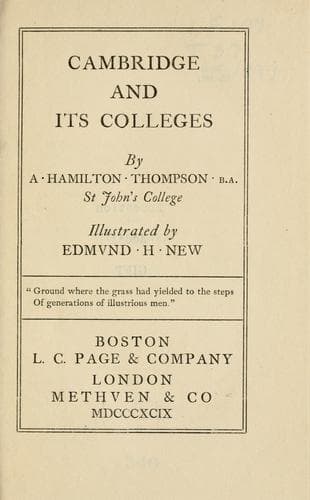
Cambridge and Its CollegesThompson, A. Hamilton (Alexander Hamilton)
History
Cambridge and Its Colleges
Thompson, A. Hamilton (Alexander Hamilton)
University of Cambridge
To the names of these ecclesiastics we may add that of Edward Hall,
fellow of King’s, who claimed direct descent from Albert II. of Austria,
and retired to Oxford. Richard Croke was a learned Grecian of King’s,
who went to Oxford in order to be near Grocyn. He found patrons in the
munificent Warham and Sir Thomas More, and was one of that _coterie_
which included Colet and Erasmus. After he had travelled abroad and
lectured in Greek at Leipsic and Louvain, he returned to England
and became Professor of Greek at Cambridge. This was in 1522. Later
on, he was engaged in the divorce, acting as Counsel to the Italian
Universities, and was made a Canon of Christ Church in 1532. He died in
1588 as Rector of Long Buckby. Yet another of his class was Dr Richard
Mulcaster, who, at a somewhat later period, transferred his talent and
vast learning to Oxford, and finally became famous as Master of Merchant
Taylors’ School.
Very seldom has royalty appeared at Cambridge with such magnificence as
on the occasion of Elizabeth’s visit in 1564. Although her actual abode
was at Queens’ College, she spent most of her time in King’s Chapel. The
provost at this time was Dr Philip Baker, who had succeeded Dr Brassie
in 1558. Elizabeth was in her element: she was in a seat of learning,
and wanted to show herself as profound as any of them. She rode to hear
Te Deum and evensong at King’s, dressed in the most gorgeous apparel
which even she could assume. At the door the public orator praised
her in long-winded Latin. When his compliments tended to the fulsome,
she said “_Non est veritas_,” when they passed probability, she said
“_Utinam!_” Next day was Sunday, and the politic Chancellor, Andrew Perne
of Peterhouse, who had burned corpses to please her sister, made a Latin
sermon before her on the text “Let every soul be subject unto the higher
powers”—a command which he himself had obeyed to the letter. The Queen
was highly pleased. Indeed, most of her visit was occupied in hearing
Latin disputations, and nothing delighted her so much as the Latin of
Matthew Hutton, who laid the foundation of his fortune by this means. On
the Sunday, after Dr Perne’s sermon, she again attended King’s Chapel for
evensong; and, in the evening, having performed her religious duties so
well, the Virgin Queen once more returned to the antechapel and witnessed
the _Aulularia_ of Plautus. This must have vexed the good puritans of
the day! It is necessary to remark that the use of college chapels for
dramatic purposes was very common, and nothing was thought of it. The
Commencements in Great St Mary’s were infinitely more impious ceremonies.
Even now, when a mastership falls vacant, many college chapels are used
for the conclave of fellows, as the chapel ensures more privacy than any
other part of the buildings.
Public-domain text, read in full here on John Shaqi.
Reviews
Reviews
No reviews yet
Be the first to share your thoughts on this work.
Join the Discussion
Join the discussion
Sign in to leave a comment or review.
Sign InorCreate an account