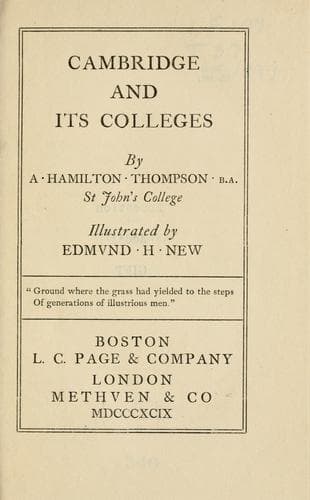
Cambridge and Its CollegesThompson, A. Hamilton (Alexander Hamilton)
History
Cambridge and Its Colleges
Thompson, A. Hamilton (Alexander Hamilton)
University of Cambridge
Dr Philip Baker, who took part in these solemn revels, was succeeded in
1569 by Dr Roger Goade, a very serious divine. His son was present at
the Synod of Dort, a fact indicative of the family’s opinions. King’s
produced, indeed, during the Tudor period, a large number of grave and
weighty persons. Sir John Cheke had been provost during the reign of
Edward VI., and, together with the violently Protestant Walter Haddon,
then fellow, and afterwards Master of Trinity Hall, had done important
work as an ecclesiastical lawyer. Then there was Giles Fletcher, brother
of the Bishop of London and uncle of the dramatist. This remarkable man
was Ambassador to the Court of Muscovy in 1588, and concluded a treaty of
commerce with Ivan the Terrible. His book “Of the Russe Commonwealthe”
has been an indispensable authority for all subsequent historians of
Russia. He was made Treasurer of St Paul’s in 1597. A more famous name
still is that of Sir Francis Walsingham, the great minister of Elizabeth.
He was a fellow commoner and left many valuable books to the library. Dr
Thomas Wylson, fellow of the college, was also a well-known politician of
the same reign. He was tutor to Elizabeth’s cousins, the young Brandons,
Dukes of Suffolk, and was ambassador to Holland in 1576. In 1577, he
became Secretary of State, and, in 1579 Dean of Durham. It is said of him
that he was “master of every subject.” His correspondence forms part of
the Harleian MSS.
At Dr Goade’s death, in 1610, we approach dangerous times. Dr Benjamin
Whichcot, a liberal puritan, became master in 1644. It is generally
supposed that his friendship with the Earl of Manchester, who occupied
Cambridge for the Parliament, was the salvation of the stained glass in
the chapel. He was far too learned a man to be bigoted, and was more of
the type of Milton than of the ordinary puritan divine. Dr Whichcot
was a classic, and advised young preachers to imitate Demosthenes and
Cicero. The gentle and metaphysical Cudworth was his friend, and he died
at Cudworth’s house in 1683, having been dispossessed of the provostship
since 1660. His memory was held long afterwards in great esteem, and a
selection from his discourses was edited by the third Lord Shaftesbury,
the pupil of John Locke and author of the _Characteristics_.
Public-domain text, read in full here on John Shaqi.
Reviews
Reviews
No reviews yet
Be the first to share your thoughts on this work.
Join the Discussion
Join the discussion
Sign in to leave a comment or review.
Sign InorCreate an account