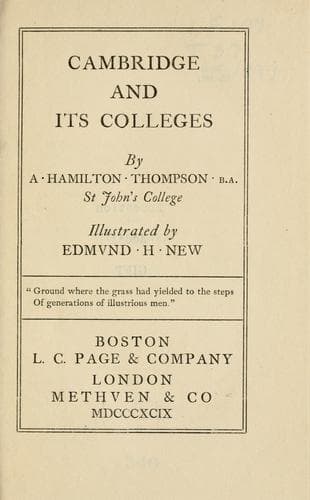
Cambridge and Its CollegesThompson, A. Hamilton (Alexander Hamilton)
History
Cambridge and Its Colleges
Thompson, A. Hamilton (Alexander Hamilton)
University of Cambridge
It is not, however, to be supposed that this noble college was at any
time without its worthies. Sir William Temple was educated here. Although
his name is doubtless an ornament to the college, he must have been
an insufferable thorn in the side of his pastors and masters, for he
was the last man in the world to have an ill conceit of himself. Two
more genial names appear later. In the absence of a portrait of the
Founder, a painting of Sir Robert Walpole hangs at the end of the hall.
He was always a loving son of the college, and his son, the even more
famous Horace,* was here as well. Charles Pratt, Earl Camden* and Lord
Chancellor of England, is another name connected with the college; and
Townshend, a third statesman of the Georgian era, was likewise brought
up at Eton and King’s. To turn aside from politics to the path of pure
learning, we find a very prodigy in the person of Thomas Hyde, afterwards
Archdeacon of Gloucester. At the age of eighteen he performed the
almost incredible task, which till then had been deemed impossible, of
transcribing the Persian Pentateuch out of its Hebrew characters. It is
scarcely surprising to find that this precocious divine did not shine in
ordinary conversation. But his learning met its recompense in a Canonry
at Christ Church, and Hebraists of his own age did not scruple to reckon
him equal as an Orientalist to Bochert and Pococke.
The name of Sumner occurs twice in the list of provosts, once in 1756
and again in 1797, and, among others of the name, John Bird Sumner,*
the famous Archbishop of Canterbury, was a King’s man. Earlier in the
century lived the painfully erudite William Coxe,* who, as Archdeacon
of Wiltshire, devoted his attention to the Duke of Marlborough and the
Hapsburg family. His researches, although their method is antiquated and
their style is hopelessly dull, are yet invaluable to the student, and
his name is not by any means the least among those of the historians
whom Cambridge has produced. But to the majority of persons, the
ecclesiastical celebrities of King’s are overshadowed by the fame of
Charles Simeon, who was a fellow of the college for considerably more
than half a century and, during that time, was a parish priest of the
town. He was the chief of those men who roused the Church of England
from her last-century apathy and revived her ancient fervour. Although
his position was, owing to circumstances, somewhat more restricted, he
was to Cambridge of his day what Cosin and Andrewes had been to the
Cambridge of theirs, and the influence which he exercised from Cambridge
over the length and breadth of England was almost unbounded. He is buried
in the antechapel of King’s beneath a stone on which his initials are
engraved, and there is a bust of him in the University Library. The
traditions which he left to King’s have never been entirely lost. The
Church of England has had few more devoted sons than the late George
Public-domain text, read in full here on John Shaqi.
Reviews
Reviews
No reviews yet
Be the first to share your thoughts on this work.
Elsewhere in the archive
Join the Discussion
Join the discussion
Sign in to leave a comment or review.
Sign InorCreate an account