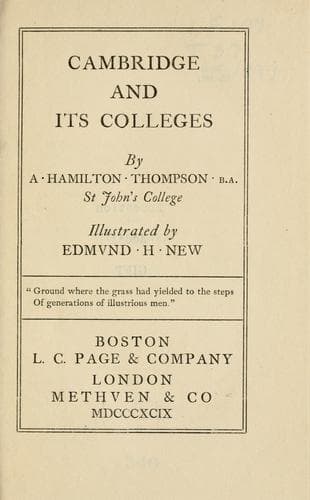
Cambridge and Its CollegesThompson, A. Hamilton (Alexander Hamilton)
History
Cambridge and Its Colleges
Thompson, A. Hamilton (Alexander Hamilton)
University of Cambridge
Williams, who, as fellow of King’s, advocated warmly the establishment of
friendly relations with the churches of the East. Older members of the
university still remember him as “Jerusalem” Williams. And, although his
life was very retired and he was seldom absent for any length of time
from Cambridge, the late William Ralph Churton, Canon of St Alban’s, was
for the last forty years of his life probably the most active of all the
English clergy in promoting missionary work and extending the Church in
the colonies.
In mentioning these names, there are others which have been necessarily
omitted. The episcopal list of the college is a long one, and includes,
among many more prelates, the famous names of Edmund Gheast, Bishop of
Rochester and Jewel’s successor at Salisbury; William Wickham, Bishop
of Lincoln and afterwards the second Bishop of that name at Winchester;
and John Pearson, Bishop of Chester, who, first a fellow here, was
subsequently Master of Trinity. Among noblemen, the great ambassador,
Stratford Canning, afterwards Lord Stratford de Redcliffe (* Herkomer),
occupies a conspicuous place. Among ordinary laymen, we find Roger
Lupton, a Jacobean worthy, founder of Sedbergh School; and, much later,
the poet, Thomas Lisle Bowles. In the antechapel, a plain stone covers
the remains of Dr Richard Okes, provost from 1850 to 1889. And close by,
under a similar stone, is buried Henry Bradshaw (* Herkomer), University
Librarian, one of the finest scholars of the century, who opened a new
epoch in the history of liturgical study. By the side of the south door
will be found a tablet in memory of the late James Kenneth Stephen,
an incomparable orator, whose little volumes of verse proved him the
successor of Calverley among Cambridge poets.
Within the last twenty years the college has undergone a complete change.
It is no longer the exclusively Etonian college which it was. Its
scholarships, with the exception of a very few, have been thrown open to
all competitors, and the large majority of undergraduates now at King’s
have never been at Eton. Although, from the standpoint of the lover of
antiquity, this departure from the Founder’s scheme is to be seriously
regretted, yet it cannot but be admitted that, in the present century,
the exclusive scheme is impracticable, and newer methods have to be
followed. At all events, the plan works very well, and in no generation
is King’s likely to lose its prestige, nor is that _esprit de corps_
which “Henry’s holy shade” seems to inspire, at all likely to diminish.
X
QUEENS’ COLLEGE
[Illustration: Queens’]
Public-domain text, read in full here on John Shaqi.
Reviews
Reviews
No reviews yet
Be the first to share your thoughts on this work.
Elsewhere in the archive
Join the Discussion
Join the discussion
Sign in to leave a comment or review.
Sign InorCreate an account