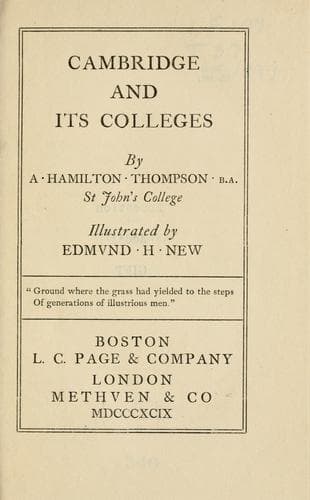
Cambridge and Its CollegesThompson, A. Hamilton (Alexander Hamilton)
History
Cambridge and Its Colleges
Thompson, A. Hamilton (Alexander Hamilton)
University of Cambridge
Returning to the eastern side of the college, we find, north of the first
court, a wing in line with the gateway-tower, continuing the front of
the college along King’s Lane. This, which was built about 1617, is not
very remarkable, and appears to have been intended for use rather than
ornament. Everything north of this is modern. The northernmost range of
chambers was built by Mr W. M. Fawcett in 1886. Although it is very good
in its way, its juxtaposition to the new court of King’s is fatal to its
beauty. Here, too, Mr Bodley has been at work. His new chapel, the most
recent addition to the buildings, is a pretty but not a very successful
piece of work. The interior is elaborately fitted with a very complete
set of stalls, and the organ-case and reredos are very fair reproductions
of medieval painting. Mr Kempe’s windows and the Flemish altar-piece
deserve admiration, but the south side of the building has been spoiled
by some very poor glass by Hardman, taken from the old chapel. Queens’,
on the whole, if we except the President’s Lodge, depends on its
delightful general effect rather than on any very special architectural
merit.
* * * * *
In 1446 Andrew Doket, rector of St Botolph’s Church, founded the College
of St Bernard for a president and four fellows. The site which he chose
for his foundation was east of the present college, and comprehended
an oblong strip of ground running from what was then Milne Street
eastwards to Trumpington Street—in fact, part of the site occupied by
St Catharine’s. Doket, who may be regarded as a second Edmund Gonville,
was first president of his college. However, his original idea was small
and its success was scarcely inevitable. Henry VI. had just founded his
splendid college at the other end of Milne Street, and Doket conceived
the happy idea of inducing his queen to perpetuate her name in the same
way. Margaret of Anjou, who was then, as Mr Atkinson points out, only
fifteen years old, showed great readiness in emulating her husband. She
consented in 1448 to refound the college under the name of the Queen’s
College of St Margaret and St Bernard, and petitioned Henry for a
charter, which was readily granted. The buildings were begun about this
time on the present site. The history of Queens’ College thus offers an
interesting parallel to that of the similarly named college at Oxford. In
both cases the first idea is due to a clerk in holy orders, who invites
the reigning queen to occupy his foundation. Margaret of Anjou has been
since looked upon as the chief foundress and benefactress of the college.
In gratitude, the society adopted her coat-of-arms, and, although this
was superseded no less than three times by other devices, it was adopted
again in 1575, and is now, with the addition of a bordure, the escutcheon
of the college. This magnificent piece of heraldry, which attracts all
eyes by its prominent situation in the first court, recalls the claims
Public-domain text, read in full here on John Shaqi.
Reviews
Reviews
No reviews yet
Be the first to share your thoughts on this work.
Elsewhere in the archive
Join the Discussion
Join the discussion
Sign in to leave a comment or review.
Sign InorCreate an account