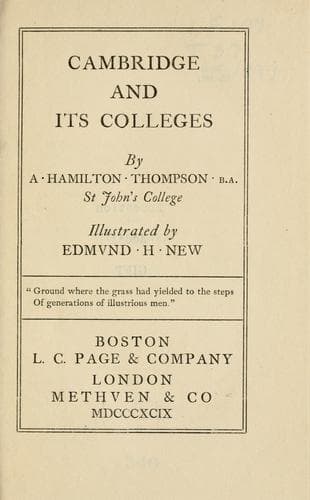
Cambridge and Its CollegesThompson, A. Hamilton (Alexander Hamilton)
History
Cambridge and Its Colleges
Thompson, A. Hamilton (Alexander Hamilton)
University of Cambridge
Queens’ disputes with Jesus the honour of being the most picturesque
college in Cambridge, and both are none the less picturesque because they
hide themselves away in a corner. Dates are here a little difficult to
determine, for the gate-tower and the two brick courts from King’s Lane
to the river are strongly marked with the stamp of medieval religion, and
part of the side towards Silver Street has an air of undiluted antiquity
which, in Cambridge, it is refreshing to recognise. Still, supposing the
present buildings to have been begun about 1475, the gate-tower cannot
have been finished long before 1500. This is clear if we compare it with
the towers at Jesus, Christ’s and St John’s, all of which were built
between 1497 and 1520, Jesus being the earliest of all. This is not the
most conspicuous of them, but it is the boldest, and the arrangement of
its corner turrets is especially admirable. The court on which it opens
is small and simple, and its features are very much the same as those
which appear in the oldest parts of St John’s. The Hall on the west side
is a restoration of the old Hall, which was brought into agreement with
last century taste. It has a pleasant interior, and the woodwork of the
doors is good. On the north side of the court is the curious sun-dial
constructed by Sir Isaac Newton; the turret on which it is displayed
is modern, but is an excellent ornament to the court. Beneath it is a
passage to the more modern part of the college, east of which is the old
chapel, a Perpendicular building much modernised by Essex in 1773.
Through the hall screens is the second court, surrounded by low,
tunnel-like cloisters with plain, wide openings in each bay. This
charming court owes a great deal of its beauty to the President’s Lodge,
which occupies the whole of the northern side. This quaint Elizabethan
building, with its high gables and bulging sides, appears to advantage
from every point, and the oriels of its picture-gallery, so arranged
that, none being opposite another, the light is equally distributed
throughout, go to make an exquisite picture which can hardly be excelled.
On the opposite side of the court, however, is the small enclosure which,
although known as Erasmus Court, has very little to remind us of Erasmus.
Essex, who did so much harm in Cambridge, rebuilt this corner of the
college in his formal manner about 1773. From the wooden bridge at the
end of the court, the damage done by this addition to the river façade
can be properly estimated. The bridge itself dates from 1746, and is said
to have been designed by Newton on a geometrical principle. It leads to
the small garden known as Erasmus’ Walk.
[Illustration: The Bridge
Queens’ College]
Public-domain text, read in full here on John Shaqi.
Reviews
Reviews
No reviews yet
Be the first to share your thoughts on this work.
Elsewhere in the archive
Join the Discussion
Join the discussion
Sign in to leave a comment or review.
Sign InorCreate an account