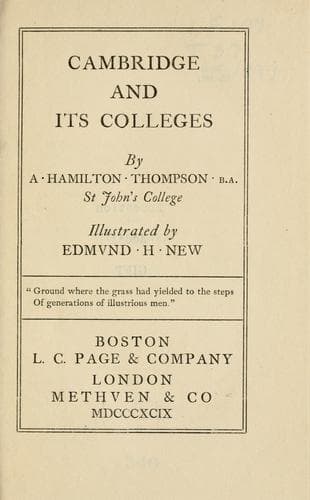
Cambridge and Its CollegesThompson, A. Hamilton (Alexander Hamilton)
History
Cambridge and Its Colleges
Thompson, A. Hamilton (Alexander Hamilton)
University of Cambridge
Doket died in 1484, and was succeeded by Thomas Wilkinson, whose rule
lasted till 1505. Then followed the three years during which John Fisher,
the celebrated Bishop of Rochester, was president. This great man was
one of that band of scholars and divines who reformed the state of
learning in England. Queens’ College probably owes to him the chief
episode in its history, the residence of Erasmus* within its walls. It
is improbable that Erasmus was at Queens’ during Fisher’s presidency,
as has been so generally supposed. He was invited to England by Henry
VIII. soon after 1509, and Fisher had given up the presidency in 1508.
No doubt, Fisher advised Erasmus, who, as Fuller says, “might have
_pickt_ and _chose_ what house he pleased,” to the cloistral seclusion
of Queens’; and this is more likely than the somewhat far-fetched
alternative that he was “allured with the situation of this Colledge
so near the River, as Rotterdam his native place to the Sea.” In fact,
Erasmus was simply allured to Cambridge by the prospect of work, and
does not seem to have enjoyed life there at all. Three of his letters
are dated from Queens’ by name, and they, as well as the rest written
from no particular address in Cambridge, prove that he regarded his work
there as a _pis aller_. He complained of his situation, his food and
drink. Cambridge beer encouraged the most painful ailments. He wrote to
a friend for a cask of Greek wine. This rare beverage was finished all
too soon; when it was done, he kept the empty cask by him, that he might
at least refresh himself with the smell. He was ill most of his time; he
was also continually in want of money. His professorships were merely
lectureships, and his pay was probably small. Had it not been for the
patronage of Archbishop Warham and other lovers of learning, he might
have fallen into serious straits. At no time did he realise the value of
money. Doubtless, he represented himself as more unpleasantly situated
than he actually was. Like most delicate men, he was very self-conscious,
and expected an inordinate amount of praise and flattery, which it is
hardly probable that he obtained at Cambridge. On a previous visit to
Oxford, he had been the centre of a group of scholars; at Cambridge,
he was isolated from his old friends. We can therefore hardly trust to
his vivacious narrative for an accurate account of his Cambridge life.
But, everything taken into consideration, he was seriously discontented,
and was glad to leave in 1514. His memory has been more than ordinarily
cherished in an University which perhaps caressed him very little in his
lifetime, and his prestige has had a salutary influence on Cambridge
scholarship. When he came to Cambridge, he found the old scholastic
learning, which he detested, still in vogue; when he left, it was with
the consciousness that he had inaugurated a new era.
Public-domain text, read in full here on John Shaqi.
Reviews
Reviews
No reviews yet
Be the first to share your thoughts on this work.
Elsewhere in the archive
Join the Discussion
Join the discussion
Sign in to leave a comment or review.
Sign InorCreate an account