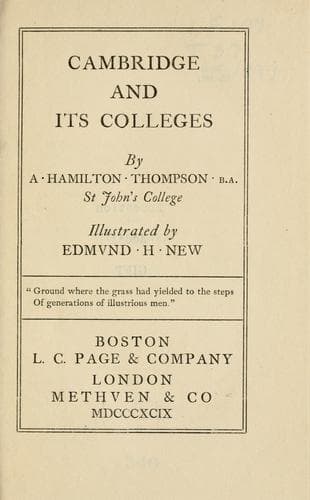
Cambridge and Its CollegesThompson, A. Hamilton (Alexander Hamilton)
History
Cambridge and Its Colleges
Thompson, A. Hamilton (Alexander Hamilton)
University of Cambridge
The next point in the history of Queens’ is its acquisition under Dr
William Mey of the Carmelite house which lay between the college and
the present site of King’s. This house was surrendered to the society
in 1538, just before the dissolution; but the interference of the Crown
delayed the completion of this transaction till 1544. The ground which
thus came into the possession of the president and fellows was the
foundation of all their future building. Dr Mey was deprived at the
accession of Queen Mary, but was restored in 1559. He lived for only a
year afterwards. His next successor but one was Dr William Chaderton,
of whom Fuller has preserved some curious anecdotes. He is reported to
have said one day in a wedding sermon “That the choice of a wife is full
of hazard, not unlike as if one in a barrel full of serpents should
grope for one fish; if (saith he) he ’scape harm of the snakes, and
light on a fish, he may be thought fortunate, for perhaps it may be but
an eel.” The ingenuity of the comparison is very characteristic of our
Elizabethan universities, and is not a little in the manner of Fuller
himself. Fuller, indeed, received most of what he would have called
his “breeding” at Queens’, and, here and at Sidney, he picked up that
curiously miscellaneous knowledge which has made him one of our most
entertaining prose writers. He was essentially a Cambridge man, and in
all his books, however distant they are from the purpose, we trace a
certain appeal to his university. He was not less positive as to its
antiquity than Dr Caius, although he went less far back for its origin.
His _Church History_ records the foundation of Cambridge as an University
by Sigebert, King of the East Anglians, and in the sequel punctiliously
refers to the foundation of every college as an important event in the
history of the Church. He did for Cambridge, in a more limited area,
what Anthony Wood did for Oxford. His politics were of an undecided kind,
and he fell into disfavour with both Parliamentarians and Royalists, but
he was, in fact, a moderate partisan of the King. There is a story that
he was to have been made a bishop at the Restoration, but he died before
the offer was made.
Public-domain text, read in full here on John Shaqi.
Reviews
Reviews
No reviews yet
Be the first to share your thoughts on this work.
Elsewhere in the archive
Join the Discussion
Join the discussion
Sign in to leave a comment or review.
Sign InorCreate an account