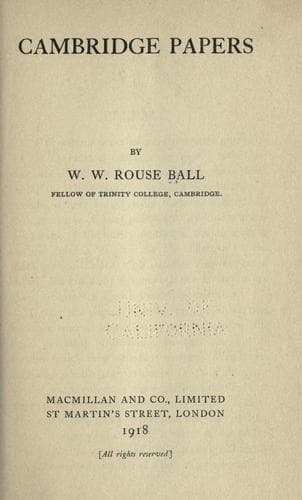
Cambridge PapersBall, W. W. Rouse (Walter William Rouse)
History
Cambridge Papers
Ball, W. W. Rouse (Walter William Rouse)
Trinity College (University of Cambridge); University of Cambridge -- History
Newton's methods, which even in the seventeenth century were archaic,
became in time quite out of date. This reason, the growth of the
subject, and the development of analysis made it desirable to expound
dynamical astronomy afresh. Towards the end of the eighteenth century
the task was undertaken by Laplace in his _Mécanique Céleste_. This is
far more than the translation of the _Principia_ into the language of
modern analysis, for it greatly extends the theory of some branches of
the subject which had been left incomplete by Newton, either on
account of his not having the requisite analysis at his command or
because the necessary facts were not available. Laplace acknowledged
his debt to Newton, and expressed his deliberate opinion that the
_Principia_ was pre-eminent over every previous production of human
genius--"so near the gods, man cannot nearer go." A century later a
fresh exposition of the subject embodying the discoveries of the
nineteenth century was given by F.F. Tisserand in his _Mécanique
Céleste_; this presents the subject in its modern form.
Newton had applied his theory to the solar system as it existed, and
had not investigated its origin. We owe to Laplace the enunciation of
a hypothesis as to its evolution. According to this conjecture, the
solar system originated in a quantity of incandescent gas rotating
round an axis through its centre of mass. Laplace assumed that as this
gas cooled, it would contract, and that successive rings would break
off from its outer edge; these rings in their turn would cool, and
finally condense into the planets with their satellites; while the sun
represents the central core which would be left. Recent investigations
show that this cannot be taken as correct without numerous
modifications. Moreover every extension of our knowledge requires the
introduction of alterations in the hypothesis, and this clearly
suggests that the conjecture is untenable. It played, however, a
useful part in its day, as suggesting a common origin for all members
of the system. Perhaps I ought to add that a nebular origin had been
previously outlined by Kant, who had also suggested meteoric
aggregations and tidal friction as agents concerned, but these were
little more than vague conjectures.
Public-domain text, read in full here on John Shaqi.
Reviews
Reviews
No reviews yet
Be the first to share your thoughts on this work.
Elsewhere in the archive
Join the Discussion
Join the discussion
Sign in to leave a comment or review.
Sign InorCreate an account