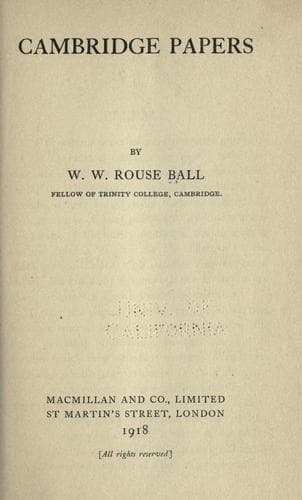
Cambridge PapersBall, W. W. Rouse (Walter William Rouse)
History
Cambridge Papers
Ball, W. W. Rouse (Walter William Rouse)
Trinity College (University of Cambridge); University of Cambridge -- History
"The Philosophy Lecturer to read first of things introductory to
natural philosophy--time, space, body, place, motion and its laws,
force, mechanical powers, gravity and its laws, hydrostatics,
projectiles solid and fluid, circular motions and the forces
relating to them. And then to read natural philosophy, beginning with
the general system of the world, and thence proceeding to the
particular constitution of this earth and the things therein--meteors,
elements, minerals, vegetables, animals, and ending with anatomy if he
have skill therein. Also to examine in logic and ethics.
"The Mathematic Lecturer to read first some easy and useful practical
hings; then Euclid, spherics, the projections of the sphere, the
construction of maps, trigonometry, astronomy, optics, music, algebra,
etc. Also to examine and (if the Tutor be deficient) to instruct in
the principles of chronology and geography.
"Several sciences which depend not on one another are all learnt in
less time together than successively, the mind being diverted and
recreated by the variety, and put more upon the stretch. And
therefore divers of these Lecturers may proceed together: suppose the
Tutor's [lectures] after morning chapel, the Greek or Philosophy
Lecturer's two hours after, and the Humanity and Mathematic
[Lecturers'] in the afternoon. The Tutor to accompany his pupils to
the philosophy and mathematic lectures, and to examine them the next
morning both in those lectures and in his own, and make them
understand where they hesitate. These two Lecturers to read five days
in the week and with the other two [Lecturers] to examine the sixth.
Each Lecturer to read the same day successively to two or three years
[_i.e._, to Freshmen, Junior Sophs, or Senior Sophs as the case may
be] under [their] several Tutors. Their lectures to begin with [the]
Michaelmas Term and continue till the Commencement [_i.e._ the end of
the Easter Term]: the Tutors to begin the Commencement before. The
Greek and Humanity Lecturers to set bigger tasks in the vacations than
in the reading-time, proportionally to the spare hours of the
students.
"A Monitor to note those who miss lectures, and give their names to
the Humanity Lecturer, who shall punish them, not by pecuniary mulcts,
but by tasks [, such as] by making verses, themes, epistles, or
getting anything without book. All pecuniary mulcts of Undergraduates
to be abolished; and exercises, admonitions, recantations, and
expulsions (according to the nature of the crime) to succeed in their
room.
"In the Long Vacation, between the Commencement and Michaelmas, the
Tutor shall take care that his Pupils read over all the last year's
lessons again by themselves, and at the end of the vacation they shall
be examined again, and those, who are at any time found not fit to go
on, turned down to the lectures of the year below, that they do not
retard the Lecturer and be an ill example to others.
Public-domain text, read in full here on John Shaqi.
Reviews
Reviews
No reviews yet
Be the first to share your thoughts on this work.
Elsewhere in the archive
Join the Discussion
Join the discussion
Sign in to leave a comment or review.
Sign InorCreate an account