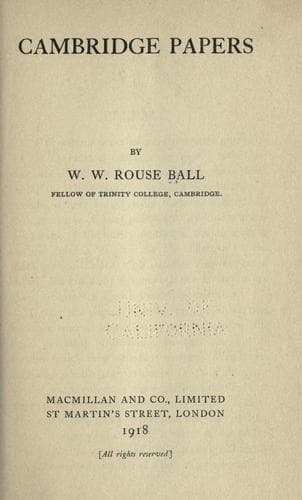
Cambridge PapersBall, W. W. Rouse (Walter William Rouse)
History
Cambridge Papers
Ball, W. W. Rouse (Walter William Rouse)
Trinity College (University of Cambridge); University of Cambridge -- History
Peacock & I are still in perfect Equilibrio & the Examiners
themselves can give no guess yet who is likely to be first;--a New
Examiner (Wood of St. John's, who is reckon'd the first
Mathematician in the University, for Waring doesn't reside) was
call'd solely to examine Peacock & me only.--but by this new Plan
nothing is yet determin'd.--So Wood is to examine us again to-morrow
morning.
_Thursday evening._
Peacock is declar'd first & I second,--Smith of this Coll. is either
8^th or 9^th & Lucas is either 10^th or 11^th.--Poor Quiz Carver is
one of the οἱ πολλοί;--I'm perfectly _satisfied_ that the Senior
Wranglership is Peacock's due, but _certainly_ not so very
undisputably as Lax pleases to represent it--I understand that _he_
asserts 'twas 5 to 4 in Peacock's favor. Now Peacock & I have
explain'd to each other how we went on, & can _prove indisputably_
that it wasn't 20 to 19 in his favor;--I _cannot_ therefore be
displeas'd for being plac'd second, tho' I'm provov'd (_sic_) with
Lax for his false report (so much beneath the Character of a
Gentleman.)--
N.B. it is my very _particular Request_ that you dont mention Lax's
behaviour to me to any one.
Such was the form ultimately taken by the senate-house examination, a
form which it retained substantially without alteration for nearly
half-a-century. It soon became the sole test by which candidates were
judged. The University was not obliged to grant a degree to anyone who
performed the statutable exercises, and it was open to the senate to
refuse to pass a supplicat for a bachelor's degree in arts unless the
candidate had presented himself for the senate-house examination. In
1790 James Blackburn, of Trinity, a questionist of exceptional
abilities, was informed that in spite of his good disputations he
would not be allowed a degree unless he also satisfied the examiners
in the tripos. He accordingly solved one "very hard problem," though
in consequence of a dispute with the authorities he refused to attempt
any more[53].
Henceforth the examination was compulsory on all candidates pursuing
the normal course for the B.A. degree. In 1791 the University laid
down rules[54] for its conduct, so far as it concerned poll-men,
decreeing that those who passed were to be classified in four
divisions or classes, the names in each class to be arranged
alphabetically, but not to be printed on the official tripos lists.
The classes in the final lists must be distinguished from the eight
preliminary classes issued before the commencement of the examination.
The men in the first six preliminary classes were expected to take
honours; those in the seventh and eighth preliminary classes were
_primâ facie_ poll-men.
Public-domain text, read in full here on John Shaqi.
Reviews
Reviews
No reviews yet
Be the first to share your thoughts on this work.
Elsewhere in the archive
Join the Discussion
Join the discussion
Sign in to leave a comment or review.
Sign InorCreate an account