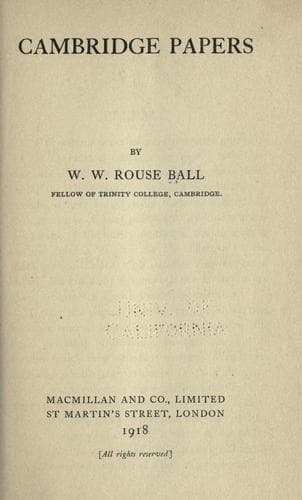
Cambridge PapersBall, W. W. Rouse (Walter William Rouse)
History
Cambridge Papers
Ball, W. W. Rouse (Walter William Rouse)
Trinity College (University of Cambridge); University of Cambridge -- History
When I went up to Trinity in 1842, I used to see a great deal of the
princess.... [I was then] a freshman full of admiration for my
College of which I used to boast. One day the old princess shewed me
the picture, ... and asked if I thought it would look well in the
Hall. On my saying what a boon it would be, she very graciously said
"You can tell Mr Whewell that I will leave it to the College through
you, and I hope you will see this picture placed in a good
position." At her death I took it down to Trinity where I was still
an undergraduate.
The portrait of queen Mary on the other side of the dais is a Spanish
copy of Antonio Moro's famous picture which hangs in Madrid. The
original is said to have been given to Philip after his engagement to
her; it presents her as a woman of strong character but far from
beautiful. When the marriage took place, it was unkindly said by a
Spanish courtier that whatever were the faults of his master, it must
at least be admitted that he recognized the obligation of a gentleman
to keep his word.
Of other pictures in the hall those of Tennyson (1809-92) painted in
1890 by G.F. Watts, of the earl of Essex (1566-1601) painted in 1590,
of Isaac Newton (1642-1727) painted in 1725 by John Vanderbank, and of
Francis Bacon (1561-1626) copied from Van Somer's portrait in Gray's
Inn are specially noticeable. Newton and Barrow (together with
Pearson who is mentioned below) played a leading part in the
intellectual life in the University towards the close of the
seventeenth century, but I need not talk here about this. Barrow, who
was a mathematician and divine, had a ready wit. When, previous to his
admission to holy orders, he was examined on his faith, the dialogue
is said to have been as follows:--Chaplain: _Quid est fides?_ Barrow:
_Quod non vides._ Chaplain: _Quid est spes?_ Barrow: _Magna res._
Chaplain: _Quid est caritas?_ Barrow: _Magna raritas._ On which his
questioner retired in dudgeon, and reported that there was a candidate
for ordination who would only give him "rhyming answers to moral
questions": but the bishop had the sense to recognize that truths can
be expressed in rhyme as well as in prose, and Barrow was ordained.
A very pleasing picture is that reputed to be of Byron: this looks
like a Raeburn, though it is ascribed to Thomas Lawrence: its history
is doubtful, but the absence of any peculiarity in the ear is _prima
facie_ evidence that it is not of Byron. Another striking portrait is
that of W.H. Thompson (1810-1886) painted in 1881 by Hubert
von Herkomer. When Thompson saw the completed portrait of himself, he
is said to have remarked, "Do I really look as if I held the world so
cheap" and in a print of it in the house of one of my friends, this is
inscribed on the frame. I ought also to call attention to the window
portrait of Richard, duke of York (1411-60), the father of Edward IV
and Richard III, which probably comes to us from King's Hall.
Public-domain text, read in full here on John Shaqi.
Reviews
Reviews
No reviews yet
Be the first to share your thoughts on this work.
Elsewhere in the archive
Join the Discussion
Join the discussion
Sign in to leave a comment or review.
Sign InorCreate an account