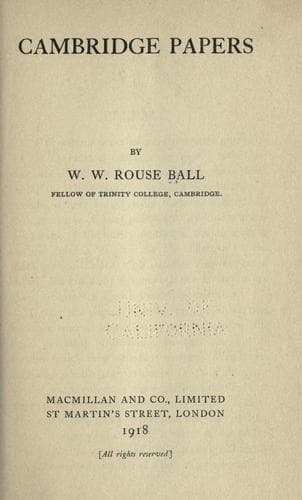
Cambridge PapersBall, W. W. Rouse (Walter William Rouse)
History
Cambridge Papers
Ball, W. W. Rouse (Walter William Rouse)
Trinity College (University of Cambridge); University of Cambridge -- History
Among other paintings, which at present hang on the hall panelling,
are portraits of the following famous members of our College:--Edward
White Benson (1829-96) archbishop of Canterbury, Isaac Hawkins Browne
(1706-60), Arthur Cayley (1821-95), the earl of Derby (1826-93),
Michael Foster (1836-1907), Francis Galton (1822-1911), the earl of
Halifax (1661-1715), Fenton John Anthony Hort (1828-92), Richard
Claverhouse Jebb (1841-1905), Joseph Joachim (1831-1907) the musician,
Thomas Jones (1756-1807), Joseph Barber Lightfoot (1828-89) bishop of
Durham, Frederick Denison Maurice (1805-72), James Clerk Maxwell
(1831-79), viscount Melbourne (1779-1849), Matthew Raine (1760-1811),
Adam Sedgwick (1785-1873), Henry Sidgwick (1838-1900), Charles John
Vaughan (1816-97), Brooke Foss Westcott (1825-1901) bishop of Durham,
John Westlake (1828-1908), and William Whewell (1794-1866).
Of these, Raine, Jones, Halifax and Hawkins Browne lived in the
eighteenth century. The last-named is known to fame through having
caused a change in the family reigning in the two Sicilies. In fact,
coming to Naples in his travels he danced at a court ceremony "with
such inconceivable alacrity and vigour" as to provoke universal
amusement and amazement: in particular the queen's laughter was so
immoderate that a miscarriage ensued. On such events may the histories
of dynasties and empires turn! He is described on this occasion as
pirouetting in a "dress of volcano silk with lava buttons": perhaps it
is in this costume that he is depicted on our walls. Having related
this anecdote I must in fairness add that he was a poet of
considerable ability, a good talker in an age when the standard of
conversation was high, and an excellent judge of wine. Most of the
portraits are, however, of celebrities of the Victorian age. Of these,
Melbourne and Derby were politicians; Benson, Hort, Lightfoot,
Vaughan, and Westcott represent the church; Westlake was a lawyer;
Jebb a scholar; Maurice and Sidgwick represent ethical philosophy;
while Cayley, Foster, Galton, Maxwell, Sedgwick, and Whewell, were men
of science.
Among the canvasses above the panelling are portraits of Richard
Bentley (1662-1742) the scholar, Edward Coke (1549-1634) the lord
chief justice, Cowley (1618-67) the poet, John Dryden (1631-1701) the
poet, the earl of Macclesfield (1666-1732), John Pearson (1613-86)
bishop of Chester, Robert Smith (1689-1768) the mathematician, and
John Wilkins (1614-72) bishop of Chester. Wilkins is now almost
unknown but he wrote some interesting books, notably one on the
ciphers employed in the civil war of the seventeenth century. Another
work of his on the possibility of a journey to the moon, provoked the
duchess of Newcastle to ask him where she could find a place to bait
if she tried the journey: "Madam," said he, "of all the people in the
world I least expected that question from you, who have built so many
castles in the air that you may lie every night in one of your own."
Public-domain text, read in full here on John Shaqi.
Reviews
Reviews
No reviews yet
Be the first to share your thoughts on this work.
Elsewhere in the archive
Join the Discussion
Join the discussion
Sign in to leave a comment or review.
Sign InorCreate an account