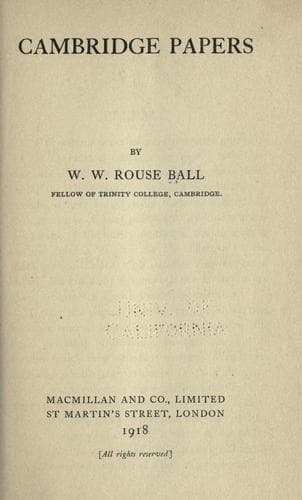
Cambridge PapersBall, W. W. Rouse (Walter William Rouse)
History
Cambridge Papers
Ball, W. W. Rouse (Walter William Rouse)
Trinity College (University of Cambridge); University of Cambridge -- History
Of our pre-commonwealth plate the oldest pieces are two silver-gilt
flagons, dated 1607-08, given us in 1636 by John and Bernard Stuart,
sons of the duke of Lennox, then about sixteen and fourteen years old.
There is in the small combination room a charming print of Vandyke's
portrait of the brothers: both boys were killed during the Civil War,
John at Edgehill and Bernard at Rowton Heath. Whistles are placed in
the handles of these flagons, so they must have been originally
intended for secular use, but they have been included, as far back as
our records go, among the communion plate: perhaps the spouts were
added when the vessels were placed in the chapel. Our next earliest
piece is the handsome cup, dated 1615-16, given us by Nevile probably
in 1615: it was originally silver-gilt. The fourth of these pieces is
a bursarial rose-water basin and ewer dated 1635-36. We owe it to
Ambrose Aykerod who was bursar in that year: his arms are engraved on
the cup, and the inscriptions on it refer to vows and pledges by him
which are now inexplicable. The only other early piece which survived
the Civil War was a cup given by John Clarkson between 1610 and 1620
and known from its inscription "Pauper Johannes Dictus Cognomine
Clarkson Hunc Cyathum Dono Gratuito Dedit" as the "Pauper Joan Pot":
this was stolen in 1798. Clarkson had matriculated as a sizar in 1553,
obtained a scholarship in due course, and graduated B.A. in 1560.
Apart from the four pieces mentioned above, the most striking objects
in our collection are the rose-water basins and ewers, the Duport
standing salt, the standing or loving cups, the tankards, and the
punch-bowls.
We have several notable rose-water basins and ewers. The earliest of
these is the set given by the earl of Kent in 1662 to commemorate the
passing of the Act of Uniformity. The date is given by a quaint double
chronogram: and the central inscription Νιψον ανομηματα μη μοναν οψιν
reads alike forwards and backwards. Another beautiful set is that
given by the duke of Buckingham in 1671, the circumference of the
basin being over seven feet. The visitor should also notice a set of
1740 bequeathed by David Humphrey, and a set of 1748 given by William
John Bankes. Another set consists of a basin of 1716 given by John
Bennet, with a graceful ewer probably made about 1675. This ewer must
have been originally a "standing cup" since a whistle is placed in the
handle, but a spout was added between 1789 and 1810 with the intention
of turning it into a flagon: on it are engraved the Trinity and
Westminster arms, and in an early catalogue it is called the Busby
cup: its donor is unknown.
Public-domain text, read in full here on John Shaqi.
Reviews
Reviews
No reviews yet
Be the first to share your thoughts on this work.
Elsewhere in the archive
Join the Discussion
Join the discussion
Sign in to leave a comment or review.
Sign InorCreate an account