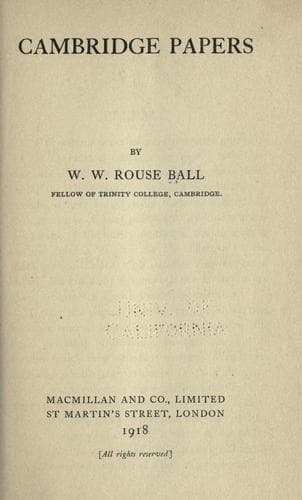
Cambridge PapersBall, W. W. Rouse (Walter William Rouse)
History
Cambridge Papers
Ball, W. W. Rouse (Walter William Rouse)
Trinity College (University of Cambridge); University of Cambridge -- History
It may be thought that I have occupied too much space in giving bare
lists of pieces of plate, but the shapes of some of the pieces are so
good and the surface of old silver, when carefully tended, has such a
beautiful texture that I believe it may be worth calling the attention
of any interested in such things to some of our possessions of this
kind. Only societies and families with continuous records dating from
a distant past can show such collections.
CHAPTER VII.
THE COLLEGE AUDITORS.
There is no reference in our earliest college statutes--those of
1552--to an Auditor, but the extant accounts show that the office
existed from the foundation of the College in 1546. Definite
regulations for the appointment were proposed in the draft statutes of
1554, and were embodied in the statutes of 1560. By these the auditor
was made one of the statutable officers of the Society: the post was
held for long periods, and it was not permissible to perform the
duties by proxy. The statute in question was re-enacted in 1844. By
the statutes of 1861 the office was made annual, and tenable only
during pleasure. It remains annual under the present statutes, but a
definite proviso was inserted in 1882 that it is not tenable by a
fellow or officer of the House, and a clause was introduced providing
for the appointment from among the fellows of an Assessor or Assessors
who should be present during the audit.
From the foundation of the College, its financial year ran from
Michaelmas to Michaelmas, and the audit of each year was concluded in
the following December. At first the annual honorarium of the auditor
seems to have been £10 with an allowance of £2 for travelling
expenses, stationery, etc., but before the end of the sixteenth
century it had been reduced to £5, with an augmentation of £3. 6s. 8d.
and some allowances.
The form of the _declaratio computi_ was much as at present, and
generally, with but small variations, it takes the form now
stereotyped "and so the said A. B. Senior (or Junior) Bursar upon the
foot of this his account for one whole year ending Michaelmas ...
oweth unto the College the sum of...." In some cases, and notably in
the seventeenth century, the sums include fractions of a penny, even
as small as one thirty-second part thereof. Presumably the audit was
always followed by a "feast," as still remains the custom.
Public-domain text, read in full here on John Shaqi.
Reviews
Reviews
No reviews yet
Be the first to share your thoughts on this work.
Elsewhere in the archive
Join the Discussion
Join the discussion
Sign in to leave a comment or review.
Sign InorCreate an account