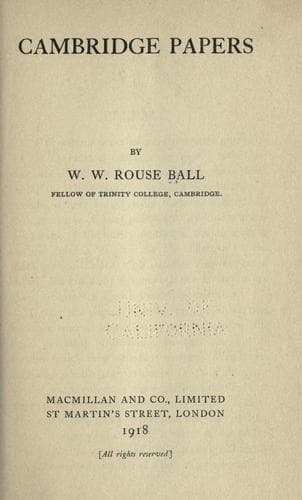
Cambridge PapersBall, W. W. Rouse (Walter William Rouse)
History
Cambridge Papers
Ball, W. W. Rouse (Walter William Rouse)
Trinity College (University of Cambridge); University of Cambridge -- History
Our predecessors, in their arrangements for the "reconcination" or
rebuilding of the Great Court, naturally attached great
importance to not interfering with King Edward's Tower which had long
been the chief entrance to King's Hall and then stood near the present
sundial. A suggested way of working this Tower into the scheme of the
court is shown on the plan which hangs on the staircase leading to the
library annexe; in this, a block one hundred feet long and thirty-four
feet broad, was to be built over an open colonnade running eastwards
from the Tower and ending in front of and a few yards from the Great
Gate. The first floor of this block might have been used for the new
library; or alternatively it might have been used for chambers, and
the new library built elsewhere, for instance, as was suggested, on
the site of the range of chambers which now stretches from the chapel
to the turret staircase adjoining the lodge.
Neither of these proposals was then adopted, and our second library
was not erected till Nevile, between 1594 and 1600, took the matter in
hand. He provided for it a room seventy-five feet long and thirty feet
broad on the second floor of the range connecting the Clock Tower and
the lodge; it has since been converted into chambers.
Less than a century after Nevile's library was finished, the Society
again found it necessary to provide more book accommodation, and the
result is the impressive and excellently designed building which
stands on the west side of Nevile's Court. According to tradition, its
erection, commenced in February 1676, was due to Barrow, then master
of the College, who in the previous year had pressed the other heads
of Houses to provide a room worthy of the University for its meetings,
and urged that it should be of the best. Such schemes are expensive
and cannot be effected without public spirit. Caution, it is said,
carried the day, whereon Barrow, piqued at this faint-heartedness,
declared that he would go to Trinity, "lay out the foundations of a
building to enlarge his back court, and close it with a stately
library, which should be more magnificent and costly than what he had
proposed.... And he was as good as his word, for that very afternoon
he ... staked out the very foundation upon which the building now
stands."
The story may be substantially true, for the long-cherished idea of
building a university theatre and library was then in the hands of a
syndicate: on the other hand the extant speech of Barrow in which he
put forward his policy was not delivered till the Easter term 1676,
and Wren's designs for such a building are referred to the year 1678
and indicate that the scheme had not been then abandoned. But whether
the anecdote be true or not, we may take it that the erection of our
library was due to Barrow's initiative, and that he personally raised
a considerable sum towards its cost.
Public-domain text, read in full here on John Shaqi.
Reviews
Reviews
No reviews yet
Be the first to share your thoughts on this work.
Elsewhere in the archive
Join the Discussion
Join the discussion
Sign in to leave a comment or review.
Sign InorCreate an account