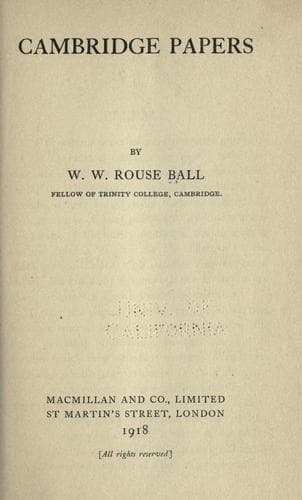
Cambridge PapersBall, W. W. Rouse (Walter William Rouse)
History
Cambridge Papers
Ball, W. W. Rouse (Walter William Rouse)
Trinity College (University of Cambridge); University of Cambridge -- History
3. Towards the close of his reign, Henry VIII determined to found a
college at Cambridge which should promote his views on religion and
the new learning. He decided to use for the purpose the buildings and
land occupied or owned by two of the chief medieval colleges, King's
Hall and Michael-House. Accordingly, under parliamentary powers, he
compelled those Societies to surrender to him their charters and
possessions, purchased such small parts of our present Great Court as
did not belong to them, and gave all this property to his new college
together with large revenues from religious houses which he had
recently dissolved. The proceedings were high-handed, but we may say
that the result justified him. It is believed that, during these
proceedings, the university careers of a few of the students, at any
rate of King's Hall, were not interrupted, and that thus our academic
life runs without a break from the days of Edward II to the present
time. Most of the buildings of Michael-House have now disappeared, but
our connection with King's Hall is still evident through the remains
of its Cloister Court, our Great Gate which bears an inscription
commemorating the permanent establishment of King's Hall by
Edward III, and our Clock Tower on which is a statue of that monarch.
To this group of buildings we must first direct attention to-morrow.
4. Trinity was far larger than the colleges to whose buildings and
property it succeeded. Of course it has had ups and downs in its
career, but it has generally occupied and still occupies a predominant
position in the University. Thus in 1564, its residents numbered three
hundred and six out of a total of one thousand two hundred and
sixty-seven in the University, while last October [1905], it had five
hundred and sixty-eight undergraduates out of a total of two thousand
eight hundred and thirty-five in the University, and two hundred
resident graduates out of one thousand and five in the University: we
now confine our normal entry to under two hundred a year, and as long
as this is so, our numbers cannot exceed a certain limit which we
have long reached, so, as the University grows, the percentage of
students on our boards decreases. The College has always recognized
that it was its duty to be a centre of learning as well as one of
higher education, and thanks to its traditions and the large number of
resident fellows, it has been able to fulfil this double duty.
Public-domain text, read in full here on John Shaqi.
Reviews
Reviews
No reviews yet
Be the first to share your thoughts on this work.
Elsewhere in the archive
Join the Discussion
Join the discussion
Sign in to leave a comment or review.
Sign InorCreate an account