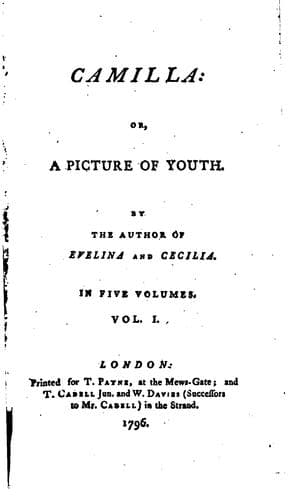
England -- Social life and customs -- Fiction; Young women -- England -- Fiction
In proportion as her pleasure from this accidental commerce was
awakened, and her early partiality revived, her own spirits re-animated,
and, in the course of the many hours they now spent completely together,
she was set so entirely at her ease, by the good humour of Mrs. Arlbery,
that she lost all fear of her wit. She found it rather playful than
satirical; rather seeking to amuse than to disconcert; and though
sometimes, from the resistless pleasure of uttering a _bon mot_ she
thought more of its brilliancy than of the pain it might inflict, this
happened but rarely, and was more commonly succeeded by regret than by
triumph.
Camilla soon observed she had, personally, nothing to apprehend,
peculiar partiality supplying the place of general delicacy, in
shielding her from every shaft that even pleasantry could render
poignant. The embarrassment, therefore, which, in ingenuous youth,
checks the attempt to please, by fear of failure, or shame of exertion,
gave way to natural spirits, which gaily rising from entertainment
received, restored her vivacity, and gradually, though unconsciously,
enabled her to do justice to her own abilities, by unaffectedly calling
forth the mingled sweetness and intelligence of her character; and Mrs.
Arlbery, charmed with all she observed, and flattered by all she
inspired, felt such satisfaction in her evident conquest, that before
the _tête-à-tête_ was closed, their admiration was become nearly
mutual.
When the evening party was announced, they both heard with surprise that
the day was so far advanced. 'They can wait, however,' said Mrs.
Arlbery, 'for I know they have nothing to do.'
She then invited Camilla to return to her the next day for a week.
Camilla felt well disposed to comply, hoping soon to reason from Edgar
his prejudice against a connection that afforded her such singular
pleasure; but to leave her father at this period was far from every
wish. She excused herself, therefore, saying, she had still six weeks
due to her uncle at Cleves, before any other engagement could take
place.
'Well, then, when you quit your home for Sir Hugh, will you beg off a
few days from him, and set them down to my account?'
'If my uncle pleases--'
'If he pleases?' repeated she, laughing; 'pray never give that _If_ into
his decision; you only put contradiction into people's heads, by asking
what pleases them. Say at once, My good uncle, Mrs. Arlbery has invited
me to indulge her with a few days at the Grove; so to-morrow I shall go
to her. Will you promise me this?'
'Dear madam, no! my uncle would think me mad.'
'And suppose he should! A little alarm now and then keeps life from
stagnation. They call me mad, I know, sometimes; wild, flighty, and what
not; yet you see how harmless I am, though I afford food for such
notable commentary.'
'But can you really like such things should be said of you?'
Public-domain text, read in full here on John Shaqi.
Reviews
Reviews
No reviews yet
Be the first to share your thoughts on this work.
Elsewhere in the archive
Join the Discussion
Join the discussion
Sign in to leave a comment or review.
Sign InorCreate an account