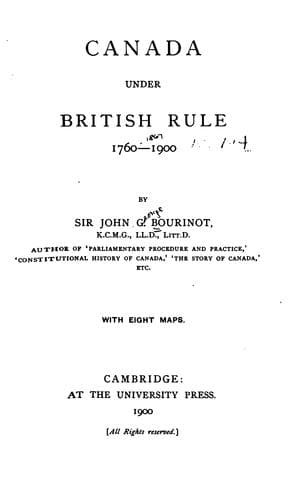
Canada under British Rule 1760-1900Bourinot, John George
History
Canada under British Rule 1760-1900
Bourinot, John George
Canada -- History
hold office "during the pleasure" of the crown, and to be called at its
will to the executive and legislative councils. Under these
circumstances they were, with some reason, believed to be more or less
under the influence of the governor-general; and particular judges
consequently fell at times under the ban of the assembly, and were
attacked on the most frivolous grounds. The assembly passed a bill
providing for the independence of the judiciary, but it had to be
reserved because it was not in accordance with the conditions considered
necessary by the crown for the protection of the bench.
The governor-general also in his message promised reforms of the
judicial and legal systems, the disposal of the funds arising from the
Jesuits' estates by the legislature, and, in fact, nearly all the
reforms which had been demanded by the house for years. Yet when the
government asked at the same time for a permanent civil list, the
message was simply referred to a committee of the whole house which
never reported. Until this time the efforts of the assembly to obtain
complete control of the public revenues and expenditures had a
justification in the fact that it is a recognised English principle that
the elected house should impose the taxes and vote the supplies; but
their action on this occasion, when the imperial government made most
important concessions, giving them full control over the public funds,
simply on condition that they should follow the English system of voting
the salaries of the judiciary and civil list, showed that the majority
were earned away by a purely factious spirit. During the progress of
these controversies, Mr. Louis Joseph Papineau, a brilliant but an
unsafe leader, had become the recognised chief of the French Canadian
majority, who for years elected him speaker of the assembly. In the
absence of responsible government, there was witnessed in those times
the extraordinary spectacle--only now-a-days seen in the American
congress--of the speaker, who should be above all political antagonisms,
acting as the leader of an arrogant majority, and urging them to
continue in their hostility to the government. It was Mr. Papineau who
first brought the governor-general directly into the arena of political
conflict by violent personal attacks; and indeed he went so far in the
case of Lord Dalhousie, a fair-minded man anxious to act moderately
within the limits of the constitution, that the latter felt compelled by
a sense of dignity to refuse the confirmation of the great agitator as
speaker in 1827. The majority in the assembly vehemently asserted their
right to elect their speaker independently of the governor, whose
confirmation was a mere matter of form, and not of statutory right; and
the only course at last open to Lord Dalhousie was to prorogue the
legislature. Mr. Papineau was re-elected speaker at the next session,
when Lord Dalhousie had gone to England and Sir James Kempt was
administrator.
Public-domain text, read in full here on John Shaqi.
Reviews
Reviews
No reviews yet
Be the first to share your thoughts on this work.
Elsewhere in the archive
Join the Discussion
Join the discussion
Sign in to leave a comment or review.
Sign InorCreate an account