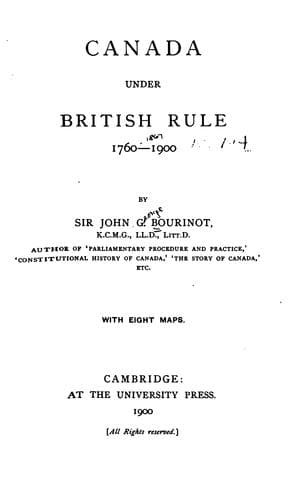
Canada under British Rule 1760-1900Bourinot, John George
History
Canada under British Rule 1760-1900
Bourinot, John George
Canada -- History
he issued a proclamation in defence of his public acts. His course in
this particular offended the ministry who, according to Lord Glenelg,
considered it a dangerous innovation, as it was practically an appeal by
a public officer to the public against the measures of parliament. Lord
Durham may be pardoned under all the circumstances for resenting at the
earliest possible moment his desertion by the government, who were bound
in honour to defend him, at all hazards, in his absence, and should not
have given him over for the moment to his enemies, led by a spiteful
Scotch lawyer. Lord Durham left Canada with the assurance that he had
won the confidence of all loyal British subjects and proved to all
French Canadians that there were English statesmen prepared to treat
them with patience, humanity and justice.
Sir John Colborne became administrator on the departure of Lord Durham,
and subsequently governor-general. Unhappily he was immediately called
upon to crush another outbreak of the rebels, in November, 1838, in the
counties watered by the Richelieu River, and in the district immediately
south of Montreal. Dr. Robert Nelson and some other rebels, who had
found refuge in the frontier towns and villages of Vermont and New York,
organised this second insurrection, which had the support of a
considerable number of _habitants_, though only a few actually took up
arms. The rising, which began at Caughnawaga, was put down at
Beauharnois, within a week from the day on which it commenced. The
authorities now felt that the time had passed for such leniency as had
been shown by Lord Durham; and Sir John Colborne accordingly established
courts-martial for the trial of the prisoners taken during this second
insurrection, as it was utterly impossible to obtain justice through the
ordinary process of the courts. Only twelve persons, however, suffered
the extreme penalty of the law; some were sent to New South Wales--where
however they were detained only a short time; and the great majority
were pardoned on giving security for good behaviour.
While these trials were in progress, and the government were anxious to
give peace and security to the province, refugees in the border states
were despatching hands of ruffians to attack and plunder the Loyalists
in the Eastern Townships; but the government of the United States
intervened and instructed its officers to take decisive measures for the
repression of every movement in the territory of a friendly Power. Thus
the mad insurrection incited by Papineau, but actually led by the
Nelsons, Chenier and Brown, came at last to an end.
Public-domain text, read in full here on John Shaqi.
Reviews
Reviews
No reviews yet
Be the first to share your thoughts on this work.
Elsewhere in the archive
Join the Discussion
Join the discussion
Sign in to leave a comment or review.
Sign InorCreate an account