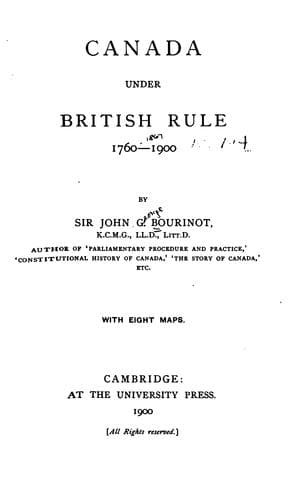
Canada under British Rule 1760-1900Bourinot, John George
History
Canada under British Rule 1760-1900
Bourinot, John George
Canada -- History
United States authorities felt compelled to imprison him for a time. It
was not until the end of 1838 that the people of the Canada were free
from filibustering expeditions organised in the neighboring states.
"Hunters' Lodges" were formed under the pledge "never to rest until all
tyrants of Britain cease to have any dominion or footing whatever in
North America." These marauding expeditions on the exposed parts of the
western frontier--especially on the St. Clair and Detroit Rivers--were
successfully resisted. At Prescott, a considerable body of persons,
chiefly youths under age, under the leadership of Von Schoultz, a Pole,
were beaten at the Old Stone Windmill, which they attempted to hold
against a Loyalist force. At Sandwich, Colonel Prince, a conspicuous
figure in Canadian political history of later years, routed a band of
filibusters, four of whom he ordered to instant death. This resolute
deed created some excitement in England, where it was condemned by some
and justified by others. Canadians, who were in constant fear of such
raids, naturally approved of summary justice in the case of persons who
were really brigands, not entitled to any consideration under the laws
of war.
In 1838 President Buren issued a proclamation calling upon all citizens
of the United States to observe the neutrality laws; but the difficulty
in those days was the indisposition of the federal government to
interfere with the states where such expeditions were organised. The
vigilance of the Canadian authorities and the loyalty of the people
alone saved the country in these trying times. A great many of the
raiders were taken prisoners and punished with the severity due to their
unjustifiable acts. Von Schoultz and eight others were hanged, a good
many were pardoned, while others were transported to Van Diemen's Land,
whence they were soon allowed to return. The names of these filibusters
are forgotten, but those of Lount and Matthews, who perished on the
scaffold, have been inscribed on some Canadian hearts as patriots. Sir
George Arthur, who succeeded Sir Francis Head, was a soldier, who had
had experience as a governor among the convicts of Van Diemen's Land,
and the negro population of Honduras, where he had crushed a revolt of
slaves. Powerful appeals were made to him on behalf of Lount and
Matthews, but not even the tears and prayers of Lount's distracted wife
could reach his heart. Such clemency as was shown by Lord Durham would
have been a bright incident in Sir George Arthur's career in Canada, but
he looked only to the approval of the Loyalists, deeply incensed against
the rebels of 1837. His action in these two cases was regarded with
disapprobation in England, and the colonial minister expressed the hope
that no further executions would occur--advice followed in the case of
other actors of the revolt of 1837. Sir George Arthur's place in
colonial annals is not one of high distinction. Like his predecessors,
Public-domain text, read in full here on John Shaqi.
Reviews
Reviews
No reviews yet
Be the first to share your thoughts on this work.
Elsewhere in the archive
Join the Discussion
Join the discussion
Sign in to leave a comment or review.
Sign InorCreate an account