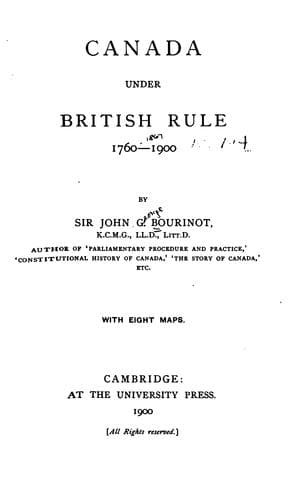
Canada under British Rule 1760-1900Bourinot, John George
History
Canada under British Rule 1760-1900
Bourinot, John George
Canada -- History
William Lyon Mackenzie is a far less picturesque figure in Canadian
history than Papineau, who possessed an eloquence of tongue and a grace
of demeanour which were not the attributes of the little peppery,
undignified Scotchman who, for a few years, played so important a part
in the English-speaking province. With his disinterestedness and
unselfishness, with his hatred of political injustice and oppression,
Canadians who remember the history of the constitutional struggles of
England will always sympathise. Revolt against absolutism and tyranny is
permissible in the opinion of men who love political freedom, but the
conditions of Upper Canada were hardly such as justified the rash
insurrection into which he led his deluded followers, many to misery and
some to death. Mackenzie lived long enough to regret these sad mistakes
of a reckless period of his life, and to admit that "the success of the
rebellion would have deeply injured the people of Canada," whom he
believed he was then serving, and that it was the interest of the
Canadian people to strengthen in every way the connection with England.
Like Papineau, he returned to Canada in 1849 to find himself entirely
unequal to the new conditions of political life, where a large
constitutional knowledge, a spirit of moderation and a statesmanlike
conduct could alone give a man influence in the councils of his country.
One historian has attempted to elevate Dr. Rolph at his expense, but a
careful study of the career of those two actors will lead fair-minded
readers to the conclusion that even the reckless course followed at the
last by Mackenzie was preferable to the double-dealing of his more
astute colleague. Dr. Rolph came again into prominence as one of the
founders of the Clear Grits, who formed in 1849 an extreme branch of the
Reform party. Dr. Rolph's qualities ensured him success in political
intrigue, and he soon became a member of the Hincks-Morin government,
which was formed on the reconstruction of the Lafontaine-Baldwin
ministry in 1851, when its two moderate leaders were practically pushed
aside by men more in harmony with the aggressive elements of the Reform
party. But Mr. Mackenzie could never win such triumphs as were won by
his wily and more manageable associate of old times. He published a
newspaper--_The Weekly Message_--replete with the eccentricities of the
editor, but it was never a financial success, while his career in the
assembly from 1851 until 1858 only proved him almost a nullity in public
affairs. Until his death in 1861 his life was a constant fight with
poverty, although his closing years were somewhat soothed by the gift of
a homestead. He might have received some public position which would
have given him comfort and rest, but he would not surrender what he
called his political freedom to the men in office, who, he believed,
wished to purchase his silence--the veriest delusion, as his influence
had practically disappeared with his flight to the United States.
Public-domain text, read in full here on John Shaqi.
Reviews
Reviews
No reviews yet
Be the first to share your thoughts on this work.
Elsewhere in the archive
Join the Discussion
Join the discussion
Sign in to leave a comment or review.
Sign InorCreate an account