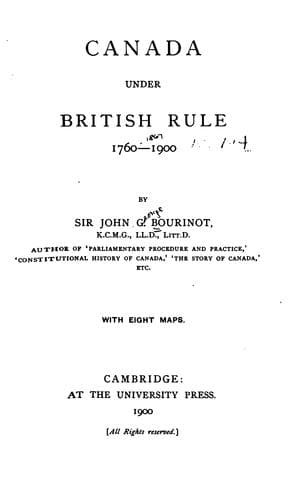
Canada under British Rule 1760-1900Bourinot, John George
History
Canada under British Rule 1760-1900
Bourinot, John George
Canada -- History
The chairman was Sir Etienne Paschal Taché, who had proved in his youth
his fidelity to England on the famous battlefield of Chateauguay, and
had won the respect of all classes and parties by the display of many
admirable qualities. Like the majority of his compatriots he had learned
to believe thoroughly in the government and institutions of Great
Britain, and never lost an opportunity of recognising the benefits which
his race derived from British connection. He it was who gave utterance
to the oft-quoted words: "That the last gun that would be fired for
British supremacy in America would be fired by a French Canadian." He
lived to move the resolutions of the Quebec convention in the
legislative council of Canada, but he died a few months before the union
was formally established in 1867, and never had an opportunity of
experiencing the positive advantages which his race, of whose interests
he was always an earnest exponent, derived from a condition of things
which gave additional guarantees for the preservation of their special
institutions. But there were in the convention other men of much greater
political force, more deeply versed in constitutional knowledge, more
capable of framing a plan of union than the esteemed and discreet
president. Most prominent among these was Mr., afterwards Sir, John A.
Macdonald, who had been for years one of the most conspicuous figures in
Canadian politics, and had been able to win to a remarkable degree the
confidence not only or the great majority of the French Canadians but
also of a powerful minority in the western province where his able
antagonist, Mr. Brown, until 1864 held the vantage ground by his
persistency in urging its claims to greater weight in the administration
of public affairs. Mr. Macdonald had a great knowledge of men and did
not hesitate to avail himself of their weaknesses in order to strengthen
his political power. His greatest faults were those of a politician
anxious for the success of his party. His strength lay largely in his
ability to understand the working of British institutions, and in his
recognition of the necessity of carrying on the government in a country
of diverse nationalities, on principles of justice and compromise. He
had a happy faculty of adapting himself to the decided current of public
opinion even at the risk of leaving himself open to a charge of
inconsistency, and he was just as ready to adopt the measures of his
opponents as he was willing to enter their ranks and steal away some
prominent men whose support he thought necessary to his political
success.
Public-domain text, read in full here on John Shaqi.
Reviews
Reviews
No reviews yet
Be the first to share your thoughts on this work.
Elsewhere in the archive
Join the Discussion
Join the discussion
Sign in to leave a comment or review.
Sign InorCreate an account