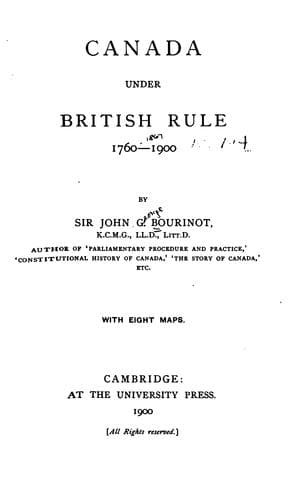
Canada under British Rule 1760-1900Bourinot, John George
History
Canada under British Rule 1760-1900
Bourinot, John George
Canada -- History
of parliamentary law, and dignity of manner enabled him to discharge
with signal ability. Mr. J.C. Chapais was a man of sound judgment, which
made him equal to the administrative duties entrusted to him from time
to time.
Of the five men sent by Nova Scotia, the two ablest were Dr., now Sir,
Charles Tupper, who was first minister of the Conservative government,
and Mr., later Sir, Adams G. Archibald, who was leader of the Liberal
opposition in the assembly. The former was then as now distinguished for
his great power as a debater and for the forcible expression of his
opinions on the public questions on which he had made up his mind. When
he had a great end in view he followed it with a tenacity of purpose
that generally gave him success. Ever since he entered public life as an
opponent of Mr. Howe, he has been a dominant force in the politics of
Nova Scotia. While Conservative in name he entertained broad Liberal
views which found expression in the improvement of the school system, at
a very low ebb when he came into office, and in the readiness and energy
with which he identified himself with the cause of the union of the
provinces. Mr. Archibald was noted for his dignified demeanour, sound
legal attainments, and clear plausible style of oratory, well calculated
to instruct a learned audience. Mr. William A. Henry was a lawyer of
considerable ability, who was at a later time elevated to the bench of
the supreme court of Canada. Mr. Jonathan J. McCully, afterwards a judge
in Nova Scotia, had never sat in the assembly, but he exercised
influence in the legislative council on the Liberal side and was an
editorial writer of no mean ability. Mr. Dickey was a leader of the
Conservatives in the upper house and distinguished for his general
culture and legal knowledge.
New Brunswick sent seven delegates, drawn from the government and
opposition. The Loyalists who founded this province were represented by
four of the most prominent members of the delegation, Tilley, Chandler,
Gray, and Fisher. Mr., afterwards Sir, Samuel Leonard Tilley had been
long engaged in public life and possessed admirable ability as an
administrator. He had for years taken a deep interest in questions of
intercolonial trade, railway intercourse and political union. He was a
Reformer of pronounced opinions, most earnest in the advocacy of
temperance, possessed of great tact and respected for his high character
in all the relations of life. In later times he became finance minister
of the Dominion and lieutenant-governor of his native province.
Public-domain text, read in full here on John Shaqi.
Reviews
Reviews
No reviews yet
Be the first to share your thoughts on this work.
Elsewhere in the archive
Join the Discussion
Join the discussion
Sign in to leave a comment or review.
Sign InorCreate an account