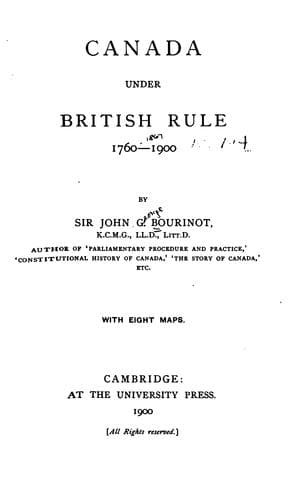
Canada under British Rule 1760-1900Bourinot, John George
History
Canada under British Rule 1760-1900
Bourinot, John George
Canada -- History
The Quebec convention sat with closed doors for eighteen days, and
agreed to seventy-two resolutions, which form the basis of the Act of
Union, subsequently passed by the imperial parliament. These resolutions
set forth at the outset that in a federation of the British American
provinces "the system of government best adapted under existing
circumstances to protect the diversified interests of the several
provinces, and secure harmony and permanency in the working of the
union, would be a general government charged with matters of common
interest to the whole country, and local governments for each of the
Canadas, and for the provinces of Nova Scotia, New Brunswick, and Prince
Edward Island, charged with the control of local matters in their
respective sections" In another paragraph the resolutions declared that
"in forming a constitution for a general government, the conference,
with a view to the perpetuation of our connection with the
mother-country, and the promotion of the best interests of the people of
these provinces, desire to follow the model of the British constitution
so far as our circumstances permit" In a subsequent paragraph it was set
forth: "the executive authority or government shall be vested in the
sovereign of the United Kingdom of Great Britain and Ireland, and be
administered according to the well-understood principles of the British
constitution, by a sovereign personally, or by the representative of the
sovereign duly authorised."
In these three paragraphs of the Quebec resolutions we see clearly
expressed the leading principles on which the Canadian federation
rests--a federation, with a central government having jurisdiction over
matters of common interest to the whole country comprised in the union,
and a number of provincial governments having the control and management
of certain local matters naturally and conveniently belonging to them,
each government being administered in accordance with the
well-understood principles of the British system of parliamentary
institutions.
The resolutions also defined in express terms the respective powers of
the central and provincial governments. Any subject that did not fall
within the enumerated powers of the provincial legislatures was placed
under the control of the general parliament. The convention recognised
the necessity of preventing, as far as possible, the difficulties that
had arisen in the working of the constitution of the United States,
where the residuary power of legislation is given to the people of the
respective states and not to the federal government. In a subsequent
chapter I give a brief summary of these and other details of the system
of government, generally laid down in the Quebec resolutions and
practically embodied in an imperial statute three years later.
Public-domain text, read in full here on John Shaqi.
Reviews
Reviews
No reviews yet
Be the first to share your thoughts on this work.
Elsewhere in the archive
Join the Discussion
Join the discussion
Sign in to leave a comment or review.
Sign InorCreate an account