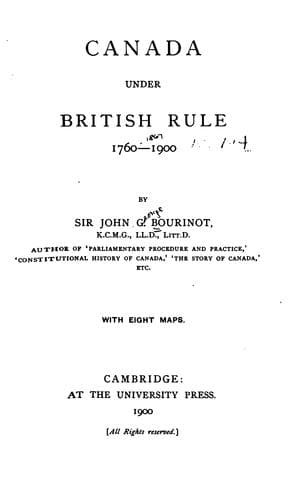
Canada under British Rule 1760-1900Bourinot, John George
History
Canada under British Rule 1760-1900
Bourinot, John George
Canada -- History
In the maritime provinces, however, the prospect for some months was far
from encouraging. Much dissatisfaction was expressed with the financial
terms, and the haste with which the maritime delegates had yielded to
the propositions of the Canadian government and given their adhesion to
the larger scheme, when they were only authorised in the first instance
by their respective legislatures to consider the feasibility of a union
of Nova Scotia, New Brunswick, and Prince Edward Island. In New
Brunswick Mr. Tilley found himself in a minority as a result of an
appeal to the people on the question in 1865, but his successor Mr.,
afterwards Sir, Albert Smith, minister of marine in the Mackenzie
government of 1873-78, was forced to resign a year later on some
question purposely raised by Lieutenant-Governor Hamilton Gordon, then
very anxious to carry the union before he left the province. A new
government was immediately formed by Mr. Peter Mitchell, a very
energetic Liberal politician--the first minister of marine in
the first Dominion ministry--who had notoriously influenced the
lieutenant-governor in his arbitrary action of practically dismissing
the Smith cabinet. On an appeal to the people Mr. Mitchell was
sustained, and the new legislature gave its approval to the union by a
large majority. The opinion then generally prevailed in New Brunswick
that a federation was essential to the security of the provinces, then
threatened by the Fenians, and would strengthen the hands of the parent
state on the American continent. In Nova Scotia the situation was
aggravated by the fact that the opposition was led by Mr. Howe, who had
always been the idol of a large party in the country, and an earnest and
consistent supporter of the right of the people to be first consulted on
every measure immediately affecting their interests. He succeeded
in creating a powerful sentiment against the terms of the
measure--especially the financial conditions--and it was not possible
during 1865 to carry it in the legislature. It was not attempted to
submit the question to the polls, as was done in New Brunswick, indeed
such a course would have been fatal to its progress; but it was
eventually sanctioned by a large vote of the two houses. A strong
influence was exerted by the fact that confederation was approved by the
imperial government, which sent out Sir Fenwick Williams of Kars as
lieutenant-governor with special instructions that, both Canada and New
Brunswick having given their consent, it was proposed to make such
changes in the financial terms as would be more favourable to the
maritime provinces. In Prince Edward Island and Newfoundland it was not
possible for the advocates of federation to move successfully in the
matter. The opposition to the scheme of union, as proposed at Quebec,
was so bitter in these two provinces that the delegates found it useless
to press the matter in their legislatures.
Public-domain text, read in full here on John Shaqi.
Reviews
Reviews
No reviews yet
Be the first to share your thoughts on this work.
Elsewhere in the archive
Join the Discussion
Join the discussion
Sign in to leave a comment or review.
Sign InorCreate an account