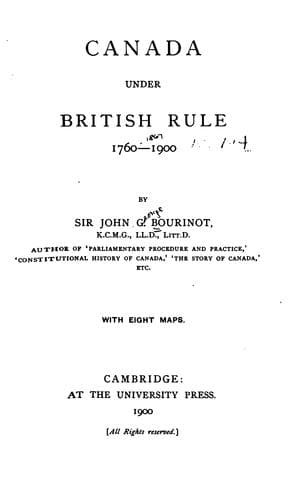
Canada under British Rule 1760-1900Bourinot, John George
History
Canada under British Rule 1760-1900
Bourinot, John George
Canada -- History
The governments of the four provinces were also regularly constituted at
this time in accordance with the act of union. The first
lieutenant-governor of Ontario was Lieutenant-General Stisted, of
Quebec, Sir Narcisse Belleau; of Nova Scotia, Lieutenant-General Sir
Fenwick Williams, the hero of Kars; of New Brunswick, Major-General
Doyle, but only for three months. With the exception of the case of
Quebec, these appointments were only temporary. It was considered
prudent to select military men in view of the continuous reports of
Fenian aggression. Sir William Howland became, a year later,
lieutenant-governor of Ontario, Major-General Sir Francis Hastings Doyle
of Nova Scotia in the fall of 1867, and Hon. L.A. Wilmot, of New
Brunswick in July 1868. The first prime minister of Ontario was Mr. John
Sandfield Macdonald, who had been leader of a Canadian ministry before
confederation. He had been a moderate Liberal in politics, and opposed
at the outset to the federal union, but before 1867 he became identified
with the Liberal-Conservative party and gave his best assistance to the
success of the federation. In Quebec, Mr. Pierre Chauveau, a man of high
culture, formed the first government, which was also associated with the
Liberal-Conservative party. In New Brunswick, Attorney-General Wetmore
was the first prime minister, but he was appointed a judge in 1870, and
Mr. George E. King, a judge of the supreme court of Canada some years
later, became his successor. In Nova Scotia, Mr. Hiram Blanchard, a
Liberal and unionist, formed a government, but it was defeated at the
elections by an overwhelming majority by the anti-unionists, and Mr.
Annand, the old friend of Mr. Howe, became first minister.
The elections for the Dominion house of commons took place in the
summer of 1867, and Sir John Macdonald's government was sustained by
nearly three-fourths of the entire representation. The most notable
incident in this contest was the defeat of Mr. Brown. Soon after his
resignation in 1866 he assumed his old position of hostility to Sir John
Macdonald and the Conservatives. At a later date, when the Liberals were
in office, he accepted a seat in the senate, but in the meantime he
continued to manage the _Globe_ and denounce his too successful and wily
antagonist in its columns with his usual vehemence.
Public-domain text, read in full here on John Shaqi.
Reviews
Reviews
No reviews yet
Be the first to share your thoughts on this work.
Elsewhere in the archive
Join the Discussion
Join the discussion
Sign in to leave a comment or review.
Sign InorCreate an account