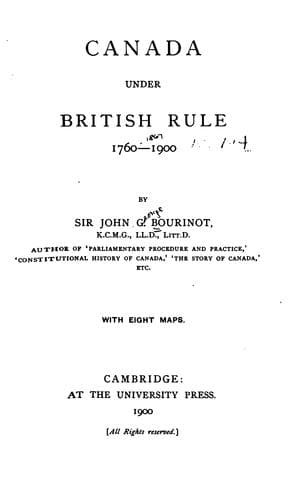
Canada under British Rule 1760-1900Bourinot, John George
History
Canada under British Rule 1760-1900
Bourinot, John George
Canada -- History
The repeal agitation in Nova Scotia received its first blow by the
defection of Mr. Howe, who had been elected to the house of commons. He
proceeded to England in 1868 with an address from the assembly of Nova
Scotia, demanding a repeal of the union, but he made no impression
whatever on a government and parliament convinced of the necessity of
the measure from an imperial as well as colonial point of view. Dr.
Tupper was present on behalf of the Dominion government to answer any
arguments that the Repealers might advance against the union. The visit
to England convinced Mr. Howe that further agitation on the question
might be injurious to British connection, and that the wisest course was
to make the union as useful as possible to the provinces. Then, as
always, he was true to those principles of fidelity to the crown and
empire which had forced his father to seek refuge in Nova Scotia, and
which had been ever the mainspring of his action, even in the trying
days when he and others were struggling for responsible government. He
believed always in constitutional agitation, not in rebellion. He now
agreed to enter the ministry as president of the council on condition
that the financial basis, on which Nova Scotia had been admitted to the
federation, was enlarged by the parliament of Canada. These "better
terms" were brought before the Canadian parliament in the session of
1869, and provided for the granting of additional allowances to the
provinces, calculated on increased amounts of debt as compared with the
maximum fixed by the terms of the British North America Act of 1867.
They met with strong opposition from Edward Blake, a very eminent
lawyer and Reformer of Ontario, on the ground that they violated the
original compact of union as set forth in the British North America Act;
but despite the opposition of the western Reformers they were ratified
by a large majority, who recognised the supreme necessity of
conciliating Nova Scotia. On account of his decision to yield to the
inevitable, Mr. Howe incurred the bitter antagonism of many men who had
been his staunch followers in all the political contests of Nova Scotia,
and it was with the greatest difficulty that he was re-elected for the
county of Hants as a minister of the crown. He remained in the
government until May, 1873, when he was appointed lieutenant-governor of
Nova Scotia. The worries of a long life of political struggles, and
especially the fatigue and exposure of the last election in Hants, had
impaired his health and made it absolutely necessary that he should
retire from active politics. Only a month after his appointment, the
printer, poet and politician died in the famous old government house,
admittance to which had been denied him in the stormy days when he
fought Lord Falkland. It was a fit ending, assuredly, to the life of the
statesman, who, with eloquent pen and voice, in the days when his
opinions were even offensive to governors and social leaders, ever urged
Public-domain text, read in full here on John Shaqi.
Reviews
Reviews
No reviews yet
Be the first to share your thoughts on this work.
Elsewhere in the archive
Join the Discussion
Join the discussion
Sign in to leave a comment or review.
Sign InorCreate an account