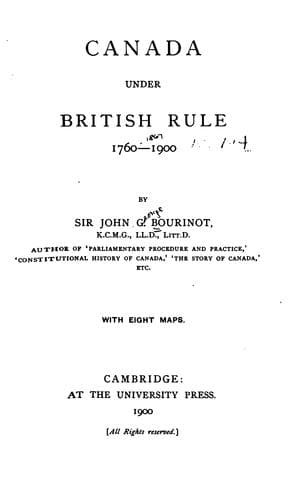
Canada under British Rule 1760-1900Bourinot, John George
History
Canada under British Rule 1760-1900
Bourinot, John George
Canada -- History
In 1871 the Dominion welcomed into the union the great mountainous
province of British Columbia, whose picturesque shores recall the
memories of Cook, Vancouver and other maritime adventurers of the last
century, and whose swift rivers are associated with the exploits of
Mackenzie, Thompson, Quesnel, Fraser and other daring men, who first saw
the impetuous waters which rush through the cañons of the great
mountains of the province until at last they empty themselves into the
Pacific Ocean. For many years Vancouver Island and the mainland, first
known as New Caledonia, were under the control of the Hudson's Bay
Company. Vancouver Island was nominally made a crown colony in 1849;
that is, a colony without representative institutions, in which the
government is carried on by a governor and council, appointed by the
crown. The official authority continued from 1851 practically in the
hands of the company's chief factor, Sir James Douglas, a man of signal
ability, who was also the governor of the infant colony. In 1856 an
assembly was called, despite the insignificant population of the island.
In 1858 New Caledonia was organised as a crown colony under the name of
British Columbia, as a consequence of the gold discoveries which brought
in many people. Sir James Douglas was also appointed governor of
British Columbia, and continued in that position until 1864. In 1866,
the colony was united with Vancouver Island under the general
designation of British Columbia. When the province entered the
confederation of Canada in 1871 it was governed by a lieutenant-governor
appointed by the crown, a legislature composed of heads of the public
departments and several elected members. With the entrance of this
province, so famous now for its treasures of gold, coal and other
minerals in illimitable quantities, must be associated the name of Sir
Joseph Trutch, the first lieutenant-governor under the auspices of the
federation. The province did not come into the union with the same
constitution that was enjoyed by the other provinces, but it was
expressly declared in the terms of union that "the government of the
Dominion will readily consent to the introduction of responsible
government when desired by the inhabitants of British Columbia."
Accordingly, soon after its admission, the province obtained a
constitution similar to that of other provinces: a lieutenant-governor,
a responsible executive council and an elective assembly. Representation
was given it in both houses of the Dominion parliament, and the members
took their seats during the session of 1872. In addition to the payment
of a considerable subsidy for provincial expenses, the Dominion
government pledged itself to secure the construction of a railway within
two years from the date of union to connect the seaboard of British
Columbia with the railway system of Canada, to commence the work
simultaneously at both ends of the line, and to complete it within ten
Public-domain text, read in full here on John Shaqi.
Reviews
Reviews
No reviews yet
Be the first to share your thoughts on this work.
Elsewhere in the archive
Join the Discussion
Join the discussion
Sign in to leave a comment or review.
Sign InorCreate an account