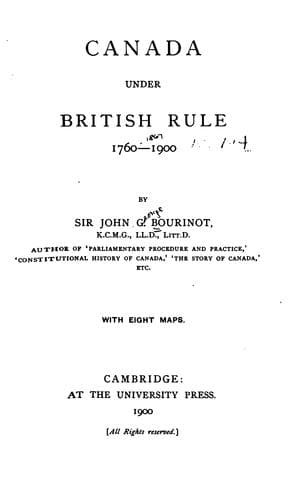
Canada under British Rule 1760-1900Bourinot, John George
History
Canada under British Rule 1760-1900
Bourinot, John George
Canada -- History
in 1888, when a resolution was proposed to the effect that the
government should have at once disallowed the act as beyond the power of
the legislature, because, among other reasons, "it recognizes the
usurpation of a right by a foreign authority, namely his Holiness the
Pope, to claim that his consent was necessary to dispose of and
appropriate the public funds of a province." The very large vote in
support of the action of the government-188 against 13-was chiefly
influenced by the conviction that, to quote the minute of council, "the
subject-matter of the act was one of provincial concern, only having
relation to a fiscal matter entirely within the control of the
legislature of Quebec." The best authorities agree in the wisdom of not
interfering with provincial legislation except in cases where there is
an indisputable invasion of Dominion jurisdiction or where the vital
interests of Canada as a whole may imperatively call for such
interference.
In March, 1885, Canada was startled by the news that the half-breeds of
the Saskatchewan district in the North-west had risen in rebellion
against the authority of the Dominion government. It is difficult to
explain clearly the actual causes of an uprising which, in all
probability, would never have occurred had it not been for the fact that
Riel had been brought back from Montana by his countrymen to assist them
in obtaining a redress of certain grievances. This little insurrection
originated in the Roman Catholic mission of St. Laurent, situated
between the north and south branches of the Saskatchewan River, and
contiguous to the British settlement of Prince Albert. Within the limits
of this mission there was a considerable number of half-breeds, who had
for the most part migrated from Manitoba after selling the "scrip[6]"
for lands generously granted to them after the restoration of order in
1870 to the Red River settlements. Government surveyors had been busily
engaged for some time in laying out the Saskatchewan country in order to
keep pace with the rapidly increasing settlement. When they came to the
mission of St. Laurent they were met with the same distrust that had
done so much harm in 1870. The half-breeds feared that the system of
square blocks followed by the surveyors would seriously interfere with
the location of the farms on which they had "squatted" in accordance
with the old French system of deep lots with a narrow frontage on the
banks of the rivers. The difficulties arising out of these diverse
systems of surveys caused a considerable delay in the issue of patents
for lands, and dissatisfied the settlers who were anxious to know what
land their titles covered. The half-breeds not only contended that their
surveys should be respected, but that they should be also allowed scrip
for two hundred and forty acres of land, as had been done in the case of
their compatriots in Manitoba. Many of the Saskatchewan settlers had
actually received this scrip before they left the province, but
Public-domain text, read in full here on John Shaqi.
Reviews
Reviews
No reviews yet
Be the first to share your thoughts on this work.
Elsewhere in the archive
Join the Discussion
Join the discussion
Sign in to leave a comment or review.
Sign InorCreate an account