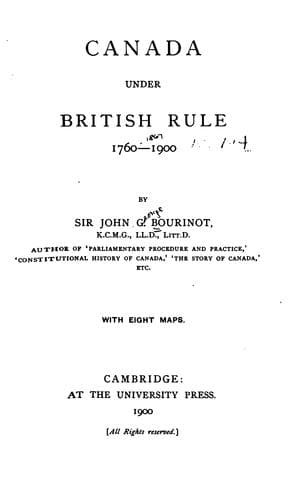
Canada under British Rule 1760-1900Bourinot, John George
History
Canada under British Rule 1760-1900
Bourinot, John George
Canada -- History
the former only saved his men from destruction by a skilful retreat to
Fort Carleton. The half-breed leaders circulated the news of this
victory over the dreaded troops of the government among the Indian bands
of the Saskatchewan, a number of whom immediately went on the war-path.
Fort Carleton had to be given up by the mounted police, who retired to
Prince Albert, the key of the district. The town of Battleford was
besieged by the Indians, but they were successfully kept in check for
weeks until the place was relieved. Fort Pitt was evacuated by Inspector
Dickens, a son of the great novelist, who succeeded in taking his little
force of police into Battleford. Two French missionaries and several
white men were ruthlessly murdered at Frog Lake by a band of Crees, and
two women were dragged from the bodies of their husbands and carried
away to the camp of Big Bear. Happily for them some tender-hearted
half-breeds purchased them from the Indians and kept them in safety
until they were released at the close of the disturbances.
The heart of Canada was now deeply stirred and responded with great
heartiness to the call of the government for troops to restore order to
the distracted settlements. The minister of militia, Mr. Adolphe
Caron--afterwards knighted for his services on this trying
occasion--showed great energy in the management of his department.
Between four and five thousand men were soon on the march for the
territories under Major-General Middleton, the English officer then in
command of the Canadian militia. Happily for the rapid transport of the
troops the Canadian Pacific Railway was so far advanced that, with the
exception of 72 miles, it afforded a continuous line of communication
from Montreal to Qu'Appelle. The railway formed the base from which
three military expeditions could be despatched to the most important
points of the Saskatchewan country--one direct to Batoche, a second to
Battleford, and a third for a flank movement to Fort Edmonton, where a
descent could be made down the North Saskatchewan for the purpose of
recapturing Fort Pitt and attacking the rebellious Indians under Big
Bear. On the 24th of April General Middleton fought his first engagement
with the half-breeds, who were skilfully concealed in rifle pits in the
vicinity of Fish Creek, a small erratic tributary of the South
Saskatchewan. Dumont for the moment succeeded in checking the advance of
the Canadian forces, who fought with much bravery but were placed at a
great disadvantage on account of Middleton not having taken sufficient
precautions against a foe thoroughly acquainted with the country and
cunningly hidden. The Canadian troops were soon able to continue their
forward movement and won a decisive victory at Batoche, in which
Colonels Williams, Straubenzie, and Grasett notably distinguished
themselves. Riel was soon afterwards captured on the prairie, but Dumont
succeeded in crossing the frontier of the United States. While Middleton
Public-domain text, read in full here on John Shaqi.
Reviews
Reviews
No reviews yet
Be the first to share your thoughts on this work.
Elsewhere in the archive
Join the Discussion
Join the discussion
Sign in to leave a comment or review.
Sign InorCreate an account