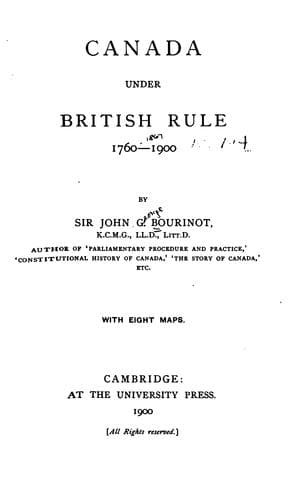
Canada under British Rule 1760-1900Bourinot, John George
History
Canada under British Rule 1760-1900
Bourinot, John George
Canada -- History
During the session of 1891 the political career of Sir Hector Langevin,
the leader of the Liberal-Conservative party in French Canada, was
seriously affected by certain facts disclosed before the committee of
privileges and elections. This committee had been ordered by the house
of commons to inquire into charges made by Mr. Israel Tarte against
another member of the house, Mr. Thomas McGreevy, who was accused of
having used his influence as a commissioner of the Quebec harbour, a
government appointment, to obtain fraudulently from the department of
public works, presided over by Sir Hector for many years, large
government contracts in connection with the Quebec harbour and other
works. The report of the majority of the committee found Mr. McGreevy
guilty of fraudulent acts, and he was not only expelled from the house
but was subsequently imprisoned in the Ottawa common gaol after his
conviction on an indictment laid against him in the criminal court of
Ontario. With respect to the complicity of the minister of public works
in these frauds the committee reported that it was clear that, while the
conspiracy had been rendered effective by reason of the confidence which
Sir Hector Langevin placed in Mr. McGreevy and in the officers of the
department, yet the evidence did not justify them in concluding that Sir
Hector knew of the conspiracy or willingly lent himself to its objects.
A minority of the committee, on the other hand, took the opposite view
of the transactions, and claimed that the evidence showed the minister
to be cognisant of the facts of the letting of the contracts, and that
in certain specified cases he had been guilty of the violation of a
public trust by allowing frauds to be perpetrated. The report of the
majority was carried by a party vote, with the exception of two
Conservative members who voted with the minority. Sir Hector Langevin
had resigned his office in the government previous to the inquiry, and
though he continued in the house for the remainder of its constitutional
existence, he did not present himself for re-election in 1896 when
parliament was dissolved.
Unhappily it was not only in the department of public works that
irregularities were discovered. A number of officials in several
departments were proved before the committee of public accounts to have
been guilty of carelessness or positive misconduct in the discharge of
their duties, and the government was obliged, in the face of such
disclosures, to dismiss or otherwise punish several persons in whom they
had for years reposed too much confidence.
Public-domain text, read in full here on John Shaqi.
Reviews
Reviews
No reviews yet
Be the first to share your thoughts on this work.
Elsewhere in the archive
Join the Discussion
Join the discussion
Sign in to leave a comment or review.
Sign InorCreate an account