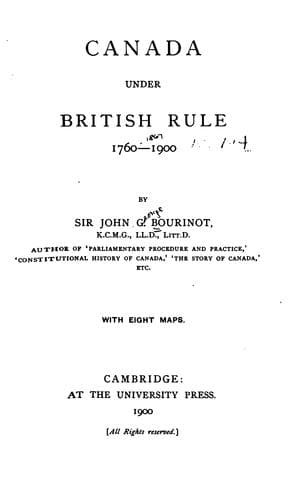
Canada under British Rule 1760-1900Bourinot, John George
History
Canada under British Rule 1760-1900
Bourinot, John George
Canada -- History
I have deemed it most convenient to reserve for the conclusion of this
history a short review of the relations that have existed for more than
a century between the provinces of the Dominion and the United States,
whose diplomacy and legislation have had, and must always have, a
considerable influence on the material and social conditions of the
people of Canada.--an influence only subordinate to that exercised by
the imperial state. I shall show that during the years when there was no
confederation of Canada--when there were to the north and north-east of
the United States only a number of isolated provinces, having few common
sympathies or interests except their attachment to the crown and
empire--the United States had too often its own way in controversial
questions affecting the colonies which arose between England and the
ambitious federal republic. On the other hand, with the territorial
expansion of the provinces under one Dominion, with their political
development, which has assumed even national attributes, with the steady
growth of an imperial sentiment in the parent state, the old condition
of things that too often made the provinces the shuttlecock of skilful
American diplomacy has passed away. The statesmen of the Canadian
federation are now consulted, and exercise almost as much influence as
if they were members of the imperial councils in London.
I shall naturally commence this review with a reference to the treaty of
1783, which acknowledged the independence of the United States, fixed
the boundaries between that country and British North America, and led
to serious international disputes which lasted until the middle of the
following century. Three of the ablest men in the United
States--Franklin, John Adams, and John Jay--succeeded by their
astuteness and persistency in extending their country's limits to the
eastern bank of the Mississippi, despite the insidious efforts of
Vergennes on the part of France to hem in the new nation between the
Atlantic and the Appalachian Range. The comparative value set upon
Canada during the preliminary negotiations may be easily deduced from
the fact that Oswald, the English plenipotentiary, proposed to give up
to the United States the south-western and most valuable part of the
present province of Ontario, and to carry the north-eastern boundary up
to the River St. John. The commissioners of the United States did not
accept this suggestion. Their ultimate object--an object actually
attained--was to make the St. Lawrence the common boundary between the
two countries by following the centre of the river and the great lakes
as far as the head of Lake Superior. The issue of negotiations so
stupidly conducted by the British commissioner, was a treaty which gave
an extremely vague definition of the boundary in the north-east between
Maine and Nova Scotia--which until 1784 included New Brunswick--and
displayed at the same time a striking example of geographical ignorance
as to the north-west.
Public-domain text, read in full here on John Shaqi.
Reviews
Reviews
No reviews yet
Be the first to share your thoughts on this work.
Elsewhere in the archive
Join the Discussion
Join the discussion
Sign in to leave a comment or review.
Sign InorCreate an account