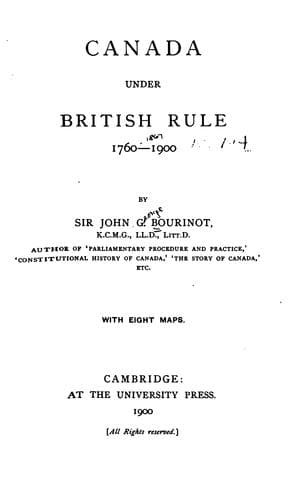
Canada under British Rule 1760-1900Bourinot, John George
History
Canada under British Rule 1760-1900
Bourinot, John George
Canada -- History
In April, 1817, the governments of Great Britain and the United States
came to an important agreement which ensured the neutrality of the great
lakes. It was agreed that the naval forces to be maintained upon these
inland waters should be confined to the following vessels: on Lakes
Champlain and Ontario to one vessel, on the Upper Lakes to two vessels,
not exceeding in each case a hundred tons burden and armed with only one
small cannon. Either nation had the right to bring the convention to a
termination by a previous notice of six months. This agreement is still
regarded by Great Britain and the United States to be in existence,
since Mr. Secretary Seward formally withdrew the notice which was given
for its abrogation in 1864, when the civil war was in progress and the
relations between the two nations were considerably strained at times.
The next international complication arose out of the seizure of the
steamer _Caroline_, which was engaged in 1837 in carrying munitions of
war between the United States and Navy Island, then occupied by a number
of persons in the service of Mr. Mackenzie and other Canadian rebels. In
1840 the authorities of New York arrested one Macleod on the charge of
having murdered a man who was employed on the _Caroline_. The
Washington government for some time evaded the whole question by
throwing the responsibility on the state authorities and declaring that
they could not interfere with a matter which was then within the
jurisdiction of the state courts. The matter gave rise to much
correspondence between the two governments, but happily for the peace of
the two countries the American courts acquitted Macleod, as the evidence
was clear that he had had nothing to do with the actual seizing of the
_Caroline_; and the authorities at Washington soon afterwards
acknowledged their responsibility in such affairs by passing an act
directing that subjects of foreign powers, if taken into custody for
acts done or committed under the authority of their own government, "the
validity or effect whereof depends upon the law of nations, should be
discharged." The dissatisfaction that had arisen in the United States on
account of the cutting out of the _Caroline_ was removed in 1842, when
Sir Robert Peel expressed regret that "some explanation and apology for
the occurrence had not been previously made," and declared that it was
"the opinion of candid and honourable men that the British officers who
executed this transaction, and their government who approved it,
intended no insult or disrespect to the sovereign authority of the
United States[9]."
[9: Hall's _Treatise on International Law_ (3rd ed.), pp. 311--313]
Public-domain text, read in full here on John Shaqi.
Reviews
Reviews
No reviews yet
Be the first to share your thoughts on this work.
Elsewhere in the archive
Join the Discussion
Join the discussion
Sign in to leave a comment or review.
Sign InorCreate an account