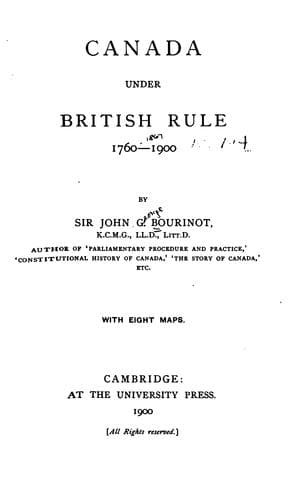
Canada under British Rule 1760-1900Bourinot, John George
History
Canada under British Rule 1760-1900
Bourinot, John George
Canada -- History
The clauses of the Washington treaty relating to the fisheries and to
trade with Canada lasted for fourteen years, and then were repealed by
the action of the United States government. In the year 1874 the
Mackenzie ministry attempted, through Mr. George Brown, to negotiate a
new reciprocity treaty, but met with a persistent hostility from leading
men in congress. The relations between Canada and the United States
again assumed a phase of great uncertainty. Canada from 1885 adhered to
the letter of the convention of 1818, and allowed no fishing vessels to
fish within the three miles limit, to transship cargoes of fish in her
ports, or to enter them for any purpose except for shelter, wood, water,
and repairs. For the infractions of the treaty several vessels were
seized, and more than one of them condemned. A clamour was raised in the
United States on the ground that the Canadians were wanting in that
spirit of friendly intercourse which should characterise the relations
of neighbouring peoples. The fact is, the Canadians were bound to adhere
to their legal rights--rights which had always been maintained before
1854; which had remained in abeyance between 1854 and 1866; which
naturally revived after the repeal of the reciprocity treaty of 1854;
which again remained in abeyance between 1871 and 1885; and were revived
when the United States themselves chose to go back to the terms of the
convention of 1818.
In 1887 President Cleveland and Mr. Secretary Bayard, acting in a
statesmanlike spirit, obtained the consent of England to a special
commission to consider the fishery question. Sir Sackville West, Mr.
Joseph Chamberlain, and Sir Charles Tupper represented England; Mr.
Bayard, then secretary of state, Mr. Putnam of Maine, and Mr. Angell of
Michigan University, represented the United States. Sir Charles Tupper
could not induce the American commissioners to consider a mutual
arrangement providing for greater freedom of commercial intercourse
between Canada and the United States. Eventually the commission agreed
unanimously to a treaty which was essentially a compromise. Foreign
fishermen were to be at liberty to go into any waters where the bay was
more than ten miles wide at the mouth, but certain bays, including the
Bay of Chaleurs, were expressly excepted in the interests of Canada from
the operation of this provision. The United States did not attempt to
acquire the right to fish on the inshore fishing-grounds of Canada--that
is, within three miles of the coasts--but these fisheries were to be
left for the exclusive use of the Canadian fishermen. More satisfactory
arrangements were made for vessels obliged to resort to the Canadian
ports in distress; and a provision was made for allowing American
fishing-vessels to obtain supplies and other privileges in the harbours
of the Dominion whenever congress allowed the fish of that country to
enter free into the market of the United States, President Cleveland in
Public-domain text, read in full here on John Shaqi.
Reviews
Reviews
No reviews yet
Be the first to share your thoughts on this work.
Elsewhere in the archive
Join the Discussion
Join the discussion
Sign in to leave a comment or review.
Sign InorCreate an account