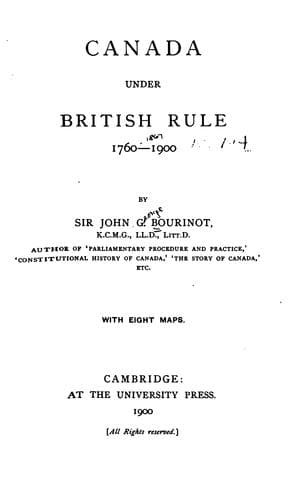
Canada under British Rule 1760-1900Bourinot, John George
History
Canada under British Rule 1760-1900
Bourinot, John George
Canada -- History
belief that there would be no rigid enforcement of old regulations which
meant the ruin of the most profitable trade of New England. The measures
of the ministry were violently assailed in parliament by Burke and
other eminent men who availed themselves of so excellent an opportunity
of exciting the public mind against a government which was doing so much
to irritate the colonies and injure British trade. All the political
conditions were unfavourable to a satisfactory adjustment of the
colonial difficulty. Chatham had been one of the earnest opponents of
the stamp act, but he was now buried in retirement--labouring under some
mental trouble--and Charles Townshend, the chancellor of the exchequer
in the cabinet of which Chatham was the real head, was responsible for
measures which his chief would have repudiated as most impolitic and
inexpedient in the existing temper of the colonies.
The action of the ministry was for years at once weak and irritating.
One day they asserted the supremacy of the British parliament, and on
the next yielded to the violent opposition of the colonies and the
appeals of British merchants whose interests were at stake. Nothing
remained eventually but the tea duty, and even that was so arranged that
the colonists could buy their tea at a much cheaper rate than the
British consumer. But by this time a strong anti-British party was in
course of formation throughout the colonies. Samuel Adams of
Massachusetts, Patrick Henry of Virginia, and a few other political
managers of consummate ability, had learned their own power, and the
weakness of English ministers. Samuel Adams, who had no love in his
heart for England, was undoubtedly by this time insidiously working
towards the independence of the colonies. Violence and outrage formed
part of his secret policy. The tea in Boston harbour was destroyed by a
mob disguised as Mohawk Indians, and was nowhere allowed to enter into
domestic consumption. The patience of English ministers was now
exhausted, and they determined to enter on a vigorous system of
repression, which might have had some effect at an earlier stage of the
revolutionary movement, when the large and influential loyal body of
people in the colonies ought to have been vigorously supported, and not
left exposed to the threats, insults, and even violence of a resolute
minority, comprising many persons influenced by purely selfish
reasons--the stoppage of illicit trade from which they had profited--as
well as men who objected on principle to a policy which seemed to them
irreconcilable with the rights of the people to the fullest possible
measure of local self-government. As it was, however, the insults and
injuries to British officials bound to obey the law, the shameless and
continuous rioting, the destruction of private property, the defiant
attitude of the opposition to England, had at last awakened the home
authorities to the dangers latent in the rebellious spirit that reckless
Public-domain text, read in full here on John Shaqi.
Reviews
Reviews
No reviews yet
Be the first to share your thoughts on this work.
Join the Discussion
Join the discussion
Sign in to leave a comment or review.
Sign InorCreate an account