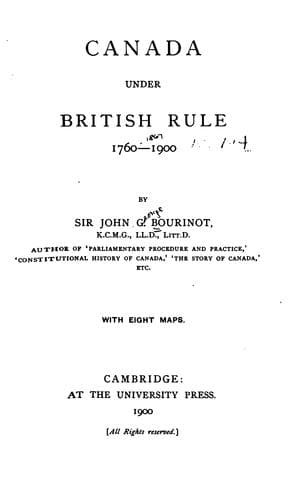
Canada under British Rule 1760-1900Bourinot, John George
History
Canada under British Rule 1760-1900
Bourinot, John George
Canada -- History
At a most critical moment, when the feelings of a large body of people
were aroused to a violent pitch, when ideas of independence were
ripening in the minds of others besides Samuel Adams, General Gage, then
in command of the British regular troops in Boston, sent a military
force to make prisoners of Adams and Hancock at Lexington, and seize
some stores at Concord. Then the "embattled farmers" fired the shot
"which was heard around the world." Then followed the capture of
Ticonderoga and Crown Point, and the battle of Bunker's Hill, on the
same day that Washington was appointed by congress to command the
continental army. At this critical juncture, John Adams and other
prominent colonists--not excepting Washington--were actually disavowing
all desire to sever their relations with the parent state in the face of
the warlike attitude of congress--an attitude justified by the
declaration that it was intended to force a redress of grievances. Tom
Paine, a mere adventurer, who had not been long in the country, now
issued his pamphlet, "Common Sense," which was conceived in a spirit
and written in a style admirably calculated to give strength and
cohesion to the arguments of the people, who had been for some time
coming to the conclusion that to aim at independence was the only
consistent and logical course in the actual state of controversy between
England and the colonies. On March 14th, 1776, the town of Boston, then
the most important in America, was given up to the rebels; and British
ships carried the first large body of unhappy and disappointed Loyalists
to Halifax. On July the fourth of the same year the Declaration of
Independence was passed, after much hesitation and discussion, and
published to the world by the continental congress assembled at
Philadelphia. The signal victory won by the continental army over
Burgoyne at Saratoga in the autumn of the following year led to an
alliance with France, without whose effective aid the eventual success
of the revolutionists would have been very doubtful The revolutionists
won their final triumph at Yorktown in the autumn of 1781, when a small
army of regulars and Loyalists, led by Cornwallis, was obliged to
surrender to the superior American and French forces, commanded by
Washington and Rochambeau, and supported by a French fleet which
effectively controlled the approaches to Chesapeake Bay.
Public-domain text, read in full here on John Shaqi.
Reviews
Reviews
No reviews yet
Be the first to share your thoughts on this work.
Elsewhere in the archive
Join the Discussion
Join the discussion
Sign in to leave a comment or review.
Sign InorCreate an account