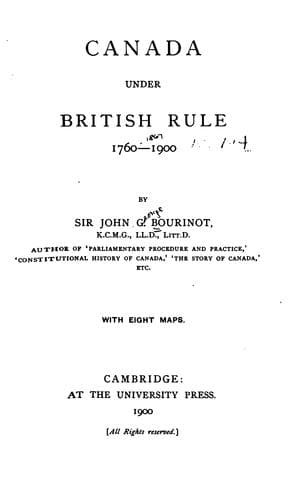
Canada under British Rule 1760-1900Bourinot, John George
History
Canada under British Rule 1760-1900
Bourinot, John George
Canada -- History
The conduct of the war on the part of England was noted for the singular
incapacity of her generals. Had there been one of any energy or ability
at the head of her troops, when hostilities commenced, the undisciplined
American army might easily have been beaten and annihilated Boston need
never have been evacuated had Howe taken the most ordinary precautions
to occupy the heights of Dorchester that commanded the town. Washington
could never have organised an army had not Howe given him every possible
opportunity for months to do so. The British probably had another grand
opportunity of ending the war on their occupation of New York, when
Washington and his relatively insignificant army were virtually in their
power while in retreat. The history of the war is full of similar
instances of lost opportunities to overwhelm the continental troops. All
the efforts of the British generals appear to have been devoted to the
occupation of the important towns in a country stretching for a thousand
miles from north to south, instead of following and crushing the
constantly retreating, diminishing, and discouraged forces of the
revolutionists. The evacuation of Philadelphia at a critical moment of
the war was another signal illustration of the absence of all military
foresight and judgment, since it disheartened the Loyalists and gave up
an important base of operation against the South. Even Cornwallis, who
fought so bravely and successfully in the southern provinces, made a
most serious mistake when he chose so weak a position as Yorktown, which
was only defensible whilst the army of occupation had free access to the
sea. Admiral Rodney, then at St. Eustatius, is open to censure for not
having sent such naval reinforcements as would have enabled the British
to command Chesapeake Bay, and his failure in this respect explains the
inability of Clinton, an able general, to support Cornwallis in his hour
of need. The moment the French fleet appeared in the Chesapeake,
Cornwallis's position became perfectly untenable, and he was obliged to
surrender to the allied armies, who were vastly superior in number and
equipment to his small force, which had not even the advantage of
fighting behind well-constructed and perfect defences. No doubt, from
the beginning to the end of the war--notably in the case of
Burgoyne--the British were seriously hampered by the dilatory and unsafe
counsels of Lord George Germaine, who was allowed by the favour of the
king to direct military operations, and who, we remember, had disgraced
himself on the famous battlefield of Minden.
Public-domain text, read in full here on John Shaqi.
Reviews
Reviews
No reviews yet
Be the first to share your thoughts on this work.
Elsewhere in the archive
Join the Discussion
Join the discussion
Sign in to leave a comment or review.
Sign InorCreate an account