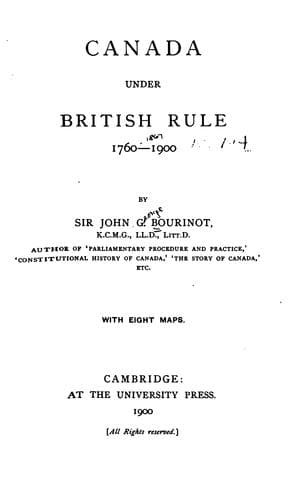
Canada under British Rule 1760-1900Bourinot, John George
History
Canada under British Rule 1760-1900
Bourinot, John George
Canada -- History
It is only within a decade of years that some historical writers in the
United States have had the courage and honesty to point out the false
impressions long entertained by the majority of Americans with respect
to the Loyalists, who were in their way as worthy of historical eulogy
as the people whose efforts to win independence were crowned with
success. Professor Tyler, of Cornell University, points out that these
people comprised "in general a clear majority of those who, of whatever
grade of culture or of wealth, would now be described as conservative
people." A clear majority of the official class, of men representing
large commercial interests and capital, of professional training and
occupation, clergymen, physicians, lawyers and teachers, "seem to have
been set against the ultimate measures of the revolution". He assumes
with justice that, within this conservative class, one may "usually find
at least a fair portion of the cultivation, of the moral thoughtfulness,
of the personal purity and honour, existing in the community to which
they happen to belong." He agrees with Dr. John Fiske, and other
historical writers of eminence in the United States, in comparing the
Loyalists of 1776 to the Unionists of the southern war of secession from
1861 until 1865. They were "the champions of national unity, as resting
on the paramount authority of the general government." In other words
they were the champions of a United British Empire in the eighteenth
century.
"The old colonial system," says that thoughtful writer Sir J.R. Seeley,
"was not at all tyrannous; and when the breach came the grievances of
which the Americans complained, though perfectly real, were smaller than
ever before or since led to such mighty consequences." The leaders among
the Loyalists, excepting a few rash and angry officials probably,
recognised that there were grievances which ought to be remedied. They
looked on the policy of the party in power in Great Britain as
injudicious in the extreme, but they believed that the relations between
the colonies and the mother-state could be placed on a more satisfactory
basis by a spirit of mutual compromise, and not by such methods as were
insidiously followed by the agitators against England. The Loyalists
generally contended for the legality of the action of parliament, and
were supported by the opinion of all high legal authorities; but the
causes of difficulty were not to be adjusted by mere lawyers, who
adhered to the strict letter of the law, but by statesmen who recognised
that the time had come for reconsidering the relations between the
colonies and the parent state, and meeting the new conditions of their
rapid development and political freedom. These relations were not to be
placed on an equitable and satisfactory basis by mob-violence and
revolution. All the questions at issue were of a constitutional
character, to be settled by constitutional methods.
Public-domain text, read in full here on John Shaqi.
Reviews
Reviews
No reviews yet
Be the first to share your thoughts on this work.
Elsewhere in the archive
Join the Discussion
Join the discussion
Sign in to leave a comment or review.
Sign InorCreate an account