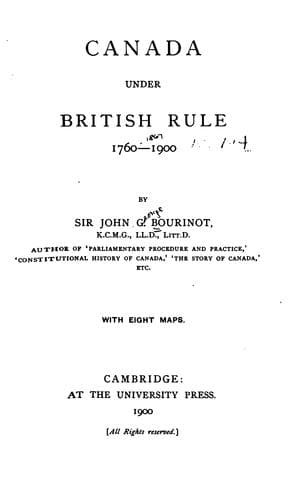
Canada under British Rule 1760-1900Bourinot, John George
History
Canada under British Rule 1760-1900
Bourinot, John George
Canada -- History
Similar opinions were entertained by Joseph Galloway, Jonathan Boucher,
Jonathan Odell, Samuel Seabury, Chief Justice Smith, Judge Thomas Jones,
Beverley Robinson and other men of weight and ability among the
Loyalists, who recognised the short-sightedness and ignorance of the
British authorities, and the existence of real grievances. Galloway, one
of the ablest men on the constitutional side, and a member of the first
continental congress, suggested a practical scheme of imperial
federation, well worthy of earnest consideration at that crisis in
imperial affairs. Eminent men in the congress of 1774 supported this
statesmanlike mode of placing the relations of England and the colonies
on a basis which would enable them to work harmoniously, and at the same
time give full scope to the ambition and the liberties of the colonial
communities thus closely united; but unhappily for the empire the
revolutionary element carried the day. The people at large were never
given an opportunity of considering this wise proposition, and the
motion was erased from the records of congress. In its place, the people
were asked to sign "articles of association" which bound them to cease
all commercial relations with England. Had Galloway's idea been carried
out to a successful issue, we might have now presented to the world the
noble spectacle of an empire greater by half a continent and
seventy-five millions of people.
But while Galloway and other Loyalists failed in their measures of
adjusting existing difficulties and remedying grievances, history can
still do full justice to their wise counsel and resolute loyalty, which
refused to assist in tearing the empire to fragments. These men, who
remained faithful to this ideal to the very bitter end, suffered many
indignities at the hands of the professed lovers of liberty, even in
those days when the questions at issue had not got beyond the stage of
legitimate argument and agitation. The courts of law were closed and the
judges prevented from fulfilling their judicial functions. No class of
persons, not even women, were safe from the insults of intoxicated
ruffians. The clergy of the Church of England were especially the object
of contumely.
Public-domain text, read in full here on John Shaqi.
Reviews
Reviews
No reviews yet
Be the first to share your thoughts on this work.
Elsewhere in the archive
Join the Discussion
Join the discussion
Sign in to leave a comment or review.
Sign InorCreate an account