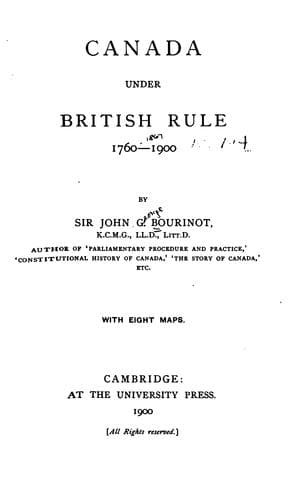
Canada under British Rule 1760-1900Bourinot, John George
History
Canada under British Rule 1760-1900
Bourinot, John George
Canada -- History
In the other provinces, happily, there were no racial differences to
divide the community and aggravate those political disputes that are
sure to arise in the working of representative institutions in a British
country. In Upper Canada for years the questions under discussion were
chiefly connected with the disposal of the public lands, which in early
times were too lavishly granted by Simcoe; and this led to the bringing
in for a while of some undesirable immigrants from the United States
--undesirable because they were imbued with republican and levelling
ideas by no means favourable to the development and stability of English
institutions of government. One of the first acts of the legislature was
the establishment of courts of law and equity, in accordance with the
practice and principles of English jurisprudence. Another very important
measure was one for the legalisation of marriages which had been
irregularly performed during early times in the absence of the clergy of
the Anglican Church by justices of the peace, and even the officers in
charge of military posts. Magistrates were still allowed to perform the
marriage ceremony according to the ritual of the Church of England, when
the services of a clergyman of that denomination were not available. Not
until 1830 were more liberal provisions passed and the clergy of any
recognised creed permitted to unite persons legally in wedlock.
It was in the second session of the first parliament of Upper Canada,
where the Loyalists were in so huge a majority, that an act was passed
"to prevent the further introduction of slaves and to limit the term of
contract for servitude within this province." A considerable number of
slave servants accompanied their Loyalist masters to the provinces at
the end of the war, and we find for many years after in the newspapers
advertisements relating to runaway servants of this class. The Loyalists
in the maritime provinces, like the same class in Upper Canada, never
gave their approval to the continuance of slavery. So early as 1800 some
prominent persons brought before the supreme court of New Brunswick the
case of one Nancy Morton, a slave, on a writ of _habeas corpus_; and her
right to freedom was argued by Ward Chipmim, one of the Loyalist makers
of New Brunswick. Although the argument in this case was not followed by
a judicial conclusion--the four judges being divided in opinion--slavery
thereafter practically ceased to exist, not only in New Brunswick, but
in the other maritime provinces, leaving behind it a memory so faint,
that the mere suggestion that there ever was a slave in either of these
provinces is very generally received with surprise, if not with
incredulity.
Public-domain text, read in full here on John Shaqi.
Reviews
Reviews
No reviews yet
Be the first to share your thoughts on this work.
Elsewhere in the archive
Join the Discussion
Join the discussion
Sign in to leave a comment or review.
Sign InorCreate an account