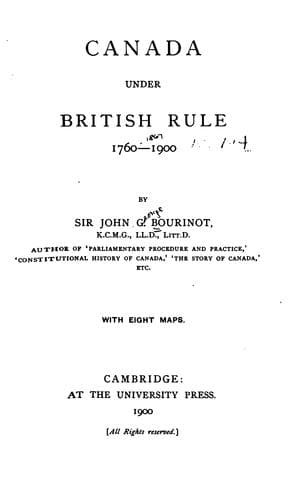
Canada under British Rule 1760-1900Bourinot, John George
History
Canada under British Rule 1760-1900
Bourinot, John George
Canada -- History
When the repeal became known some weeks later in Canada and the United
States, the province of Upper Canada had been actually invaded by Hull,
and the government of the United States had no desire whatever to desist
from warlike operations, which, they confidently believed, would end in
the successful occupation of Canada at a time when England was unable,
on account of her European responsibilities, to extend to its defenders
effective assistance.
SECTION 2.--Canada during the war.
In 1812 there were five hundred thousand people living in the provinces
of British North America. Of this number, the French people of Lower
Canada made up at least one half. These people had some grievances, and
political agitators, notably the writers of the _Canadien_, were
creating jealousies and rivalries between the French and English races
chiefly on the ground of the dominant influence of the British minority
in the administration of public affairs. On the whole, however, the
country was prosperous and the people generally contented with British
rule, the freedom of which presented such striking contrast to the
absolutism of the old French régime. The great majority of the eighty
thousand inhabitants of Upper or Western Canada were Loyalists or
descendants of Loyalists, who had become deeply attached to their new
homes, whilst recalling with feelings of deep bitterness the sufferings
and trials of the American revolution. This class was naturally attached
to British rule and hostile to every innovation which had the least
semblance of American republicanism. In the western part of the province
of Upper Canada there was, however, an American element composed of
people who had been brought into the country by the liberal grants of
land made to settlers, and who were not animated by the high sentiments
of the Loyalists of 1783 and succeeding years. These people, for some
years previous to 1812, were misled by political demagogues like Wilcox
and Marcle, both of whom deserted to the enemy soon after the outbreak
of the war. Emissaries from the republic were busily engaged for months,
we now know, in fomenting a feeling against England among these later
immigrants, and in persuading them that the time was close at hand when
Canada would be annexed to the federal republic. Some attempts were even
made to create discontent among the French Canadians, but no success
appears to have followed these efforts in a country where the bishop,
priests and leading men of the rural communities perfectly appreciated
the value of British connection.
Public-domain text, read in full here on John Shaqi.
Reviews
Reviews
No reviews yet
Be the first to share your thoughts on this work.
Elsewhere in the archive
Join the Discussion
Join the discussion
Sign in to leave a comment or review.
Sign InorCreate an account