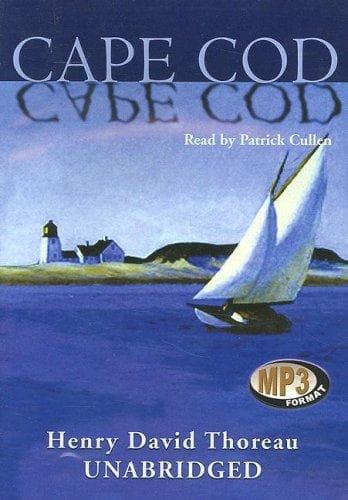
The mackerel fleet had nearly all got in before us, it being Saturday
night, excepting that division which had stood down towards Chatham in
the morning; and from a hill where we went to see the sun set in the
Bay we counted two hundred goodly looking schooners at anchor in the
harbor at various distances from the shore, and more were yet coming
round the Cape. As each came to anchor, it took in sail and swung round
in the wind, and lowered its boat. They belonged chiefly to Wellfleet,
Truro, and Cape Ann. This was that city of canvas which we had seen
hull down in the horizon. Near at hand, and under bare poles, they were
unexpectedly black-looking vessels, μέλαιναι νῆες. A fisherman told us
that there were fifteen hundred vessels in the mackerel fleet, and that
he had counted three hundred and fifty in Provincetown Harbor at one
time. Being obliged to anchor at a considerable distance from the shore
on account of the shallowness of the water, they made the impression of
a larger fleet than the vessels at the wharves of a large city. As they
had been manœuvring out there all day seemingly for our entertainment,
while we were walking north-westward along the Atlantic, so now we
found them flocking into Provincetown Harbor at night, just as we
arrived, as if to meet us, and exhibit themselves close at hand.
Standing by Race Point and Long Point with various speed, they reminded
me of fowls coming home to roost.
These were genuine New England vessels. It is stated in the Journal of
Moses Prince, a brother of the annalist, under date of 1721, at which
time he visited Gloucester, that the first vessel of the class called
schooner was built at Gloucester about eight years before, by Andrew
Robinson; and late in the same century one Cotton Tufts gives us the
tradition with some particulars, which he learned on a visit to the
same place. According to the latter, Robinson having constructed a
vessel which he masted and rigged in a peculiar manner, on her going
off the stocks a bystander cried out, “_O, how she scoons!_” whereat
Robinson replied, “_A schooner let her be!_” “From which time,” says
Tufts, “vessels thus masted and rigged have gone by the name of
schooners; before which, vessels of this description were not known in
Europe.” (See Mass. Hist. Coll., Vol. IX., 1st Series, and Vol. I., 4th
Series.) Yet I can hardly believe this, for a schooner has always
seemed to me—the typical vessel.
According to C. E. Potter of Manchester, New Hampshire, the very word
_schooner_ is of New England origin, being from the Indian _schoon_ or
_scoot_, meaning to rush, as Schoodic, from _scoot_ and _anke_, a place
where water rushes. N. B. Somebody of Gloucester was to read a paper on
this matter before a genealogical society, in Boston, March 3, 1859,
according to the _Boston Journal_, q. v.
Public-domain text, read in full here on John Shaqi.
Reviews
Reviews
No reviews yet
Be the first to share your thoughts on this work.
Elsewhere in the archive
Join the Discussion
Join the discussion
Sign in to leave a comment or review.
Sign InorCreate an account