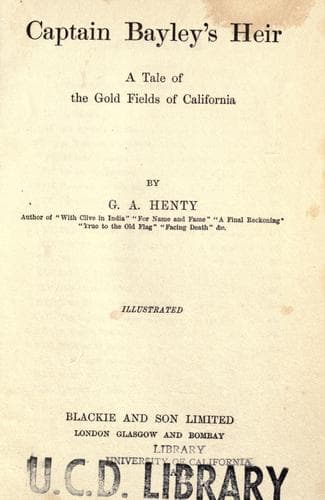
Captain Bayley's Heir: A Tale of the Gold Fields of CaliforniaHenty, G. A. (George Alfred)
General
Captain Bayley's Heir: A Tale of the Gold Fields of California
Henty, G. A. (George Alfred)
California -- Gold discoveries -- Juvenile fiction
The Indians were not visible until they reached a spot about three
hundred yards from the waggons. As they dashed up the rise they checked
their horses. Instead of seeing, as they had expected, everything in
confusion and dismay, not a soul was visible, and the clumps of waggons
stood, one on either side, ranged as for defence. However, after waiting
for three days for their prey, they were not to be balked. Their wild
war-cry rose in the air, and the two bodies of horsemen charged down on
the travellers.
In an instant a deadly fire broke out, the men kneeling in the bottom of
the waggons and resting their rifles on the rail, the tilt being raised
a few inches to enable them to see under it. Every shot told among the
mass of horsemen. The emigrants were all new to Indian warfare, but most
of them were farmers accustomed from boyhood to the use of the rifle,
and the coolness of the hunters, and their preparation for attack,
steadied them, and gave them confidence. Several of the Indians fell at
the first discharge, but the advance was not checked, and at full speed
they came on.
"Steady, lads; don't throw away a shot," Abe shouted, as the men loaded
and discharged their rifles as quickly as possible; "see that every
bullet tells."
Already the Indians were checking the speed of their horses, for the
position was a most difficult one to attack. It could not be surrounded,
and, indeed, could only be attacked on the face of the outside waggons,
from which a stream of fire was pouring. As the leaders came on Frank
and the two hunters, who both, like himself, carried revolvers, laid
aside their rifles and brought these deadly weapons into action, resting
them on the rail to secure an accurate fire. The quick, sharp cracks of
these, followed in almost every case by the fall of one of the horsemen
in front, completed the dismay of the Indians. Quick as thought, those
who had fallen were lifted across the horses of their comrades, and the
whole band, turning, galloped away at full speed, pursued, as long as
they were in sight, by the rifle-balls of the defenders of the waggons.
"So much for them," Abe said, as he leapt to the ground. "Now let us
give a hand to our comrades."
The fight was still raging on the other side. The number of waggons was
larger, and the facilities for defence less. The waggons were surrounded
by a throng of Indians, who were cutting at them with their tomahawks,
discharging their rifles into the tilts, and some, having thrown
themselves from their horses, were endeavouring to climb up. The
defenders were still fighting desperately. They had no longer time to
load, but with hatchets and clubbed rifles beat down the Indians who
tried to climb the waggons. A few minutes, however, would have ended the
resistance had not help been at hand.
Public-domain text, read in full here on John Shaqi.
Reviews
Reviews
No reviews yet
Be the first to share your thoughts on this work.
Elsewhere in the archive
Join the Discussion
Join the discussion
Sign in to leave a comment or review.
Sign InorCreate an account