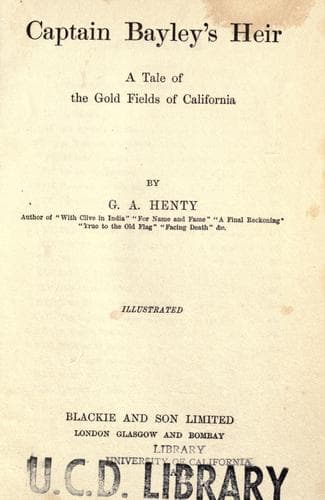
Captain Bayley's Heir: A Tale of the Gold Fields of CaliforniaHenty, G. A. (George Alfred)
General
Captain Bayley's Heir: A Tale of the Gold Fields of California
Henty, G. A. (George Alfred)
California -- Gold discoveries -- Juvenile fiction
"I see no sign of movement," Abe said to John Little, "and thar seems to
be a lot of dark objects lying about. I will ride forward with my mates.
If, as I calculate, there has been a massacre, you had better take the
waggons a detour a mile round, so that the women and children may be
spared the sight of it. It would be enough to make them skeery for the
rest of the journey."
Abe and his comrades galloped forward.
"Have your rifles ready," the former said; "there may be some of the
varmint hiding about still, though I don't think it likely. I expect the
attack took place some days back."
On nearing the waggons their apprehensions were verified. Around lay the
carcasses of the oxen with bales and boxes broken open and rifled of
their contents. In and near the waggons were the bodies of their
defenders, mingled with those of the women and children. All had been
scalped, and the bodies were mutilated with gashes of the tomahawks. No
attempt had been made to put the waggons into any position of defence;
they still stood in a long line, as they had been travelling when the
Indians fell upon them. There were twelve waggons, and they counted
eighty bodies lying around them.
"It has been a regular surprise," Abe said, "and I expect there war very
little fighting. The Injins burst out on them, there war a wild panic, a
few shots war fired, and it war all over; that's how I read it. Hillo!
what's that?"
A deep growl was heard, and turning they saw under a bush a mastiff,
standing over the body of a child. The animal could with difficulty keep
its legs; it had been pierced by a lance, and had received a blow with a
tomahawk on the head which had nearly cut off one of its ears. It had
doubtless been left for dead, but had recovered itself, and crawled to
the side of one of the children of the family to which it belonged. Its
head was covered with matted blood, and its tongue hung out, black and
parched with thirst; but it growled savagely, its hair bristled on its
back, and it prepared to defend to the last the body of its young
master.
"Poor fellow!" Frank said, dismounting. "Poor old boy, we are friends."
At the kind tones of the voice the dog relaxed the fierceness of its
aspect, it gave a faint whine, and lay down by the child's body. Frank
took off his thick felt hat, filled it with water from the skin hanging
from his saddle, and carried it to the dog. The animal raised itself
again with an effort, and drank eagerly; when it had finished, it thrust
its great nose into Frank's hand and wagged its tail, then it returned
to the body and gave a piteous howl. The tears stood in Frank's eyes.
"Lend a hand with your knives," he said to his comrades, who were
looking on; "let us dig a grave for the child, then the dog will perhaps
follow us; it is a grand dog, and I should like to have it."
Public-domain text, read in full here on John Shaqi.
Reviews
Reviews
No reviews yet
Be the first to share your thoughts on this work.
Elsewhere in the archive
Join the Discussion
Join the discussion
Sign in to leave a comment or review.
Sign InorCreate an account