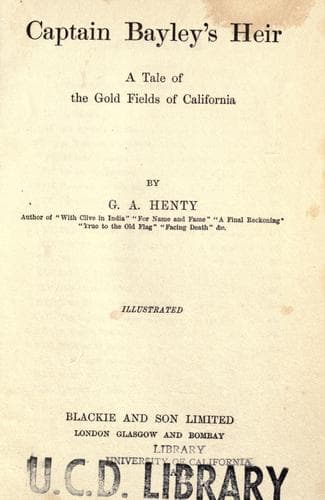
Captain Bayley's Heir: A Tale of the Gold Fields of CaliforniaHenty, G. A. (George Alfred)
General
Captain Bayley's Heir: A Tale of the Gold Fields of California
Henty, G. A. (George Alfred)
California -- Gold discoveries -- Juvenile fiction
But in the early days of gold discovery the very existence of these beds
of gravel was unknown, and gold was obtained only in the ravines and
valleys by washing the soil in the bottom. It had already been
discovered that the soil was richer the further the searchers went
down, by far the greater finds being made when the diggers reached the
solid rock at the bottom, in the irregularities of which, worn by water
thousands of years before, large quantities of rough gold were often
discovered.
There was no difficulty in following the track through the forest, and
after two days' travelling the party arrived at the first mining
village. They chose a piece of ground for their camp, fastened their
horses to stumps, erected a tent of blankets, and placed in it the
stores brought on their baggage-horses, which had remained untouched
since they started. Then, leaving one of their number in charge, they
started off to visit the diggings.
The whole of the bottom of the narrow valley was a scene of life and
bustle. The existence of gold in the valley had been discovered but
three weeks before, but a rush had taken place from other diggings. The
ground had been allotted out, and a number of tents pitched, and rough
huts erected. Men were working as if for bare life. The lots were small,
and the ground was already perfectly honeycombed with holes. Generally
the diggers worked in batches of four or five, each member of which took
up a claim, so that the space for operations was enlarged.
Two men laboured with pick and shovel, and the baskets, as they were
filled with earth and sand, were first screened in a sieve to remove the
larger portion of stones and rock, and were then poured into what was
known as a cradle, which was a long trough on rockers; one man brought
water in buckets from the stream, and poured it into this, while another
kept the cradle in constant motion. The mud and lighter portions of
stone flowed away over the edge, or were swept off by the hand of the
men employed in working it, the particles of gold sinking to the bottom
of the machine, where they were found at the clean-up at the end of the
day's work.
The new-comers looked on with great interest at the work, asking
questions as to the luck which attended the operators. The majority gave
but a poor account of their luck, the value of the finds at the end of
the day being barely sufficient to pay the enormous rate charged for
provisions, which had to be carried up from the coast some hundreds of
miles away. The stores were brought in waggons as far as Sacramento, and
from that town were carried to the diggings on the backs of mules and
horses. Consequently it was impossible for a man to live on the poorest
necessities of life for less than three or four dollars a day, and in
the out-of-the-way valleys the cost was often considerably more.
Public-domain text, read in full here on John Shaqi.
Reviews
Reviews
No reviews yet
Be the first to share your thoughts on this work.
Elsewhere in the archive
Join the Discussion
Join the discussion
Sign in to leave a comment or review.
Sign InorCreate an account