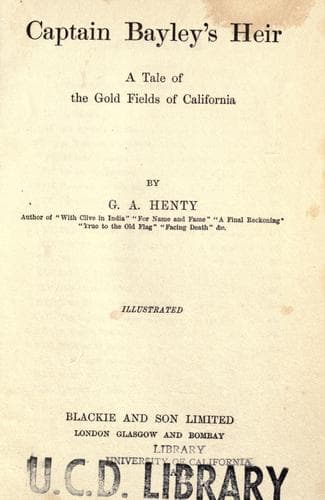
Captain Bayley's Heir: A Tale of the Gold Fields of CaliforniaHenty, G. A. (George Alfred)
General
Captain Bayley's Heir: A Tale of the Gold Fields of California
Henty, G. A. (George Alfred)
California -- Gold discoveries -- Juvenile fiction
The next day the cradle was made by Abe and Frank, the others setting to
to dig and wash out in a bucket. At the end of a day of hard work they
had got about a quarter of an ounce of glittering yellow dust. This was
not paying work, but they were not disappointed; they had not expected
to strike upon good ground at the first attempt, and were quite
satisfied by the fact that they really had met with the gold which they
had come so far to seek.
That evening Abe made a bargain to bring up goods from Sacramento for
one of the store-keepers, having previously found the rate which was
current. At daybreak next morning he and Frank started off on horseback,
each with three horses tied, head and tail, behind the one he was
riding, Turk marching gravely by their side.
The distance to Sacramento was upwards of seventy miles. On their road
they met numerous parties making their way up the mountains. All carried
a pick and shovel, a bucket and blanket, and a small sack with flour and
bacon. Many of them were sailors, who had deserted from their ships at
San Francisco, where scores of vessels were lying unable to leave for
want of hands.
All, as they passed, asked the last news from the diggings, where the
last rush was, and what was the average take at the camp, and then
hurried on, eager to reach the spot where, as every man believed,
fortune awaited him.
Two days of travel down the mountains took them to Sacramento. Here
their saddles were disposed of, and pack-saddles bought. The horses
were laden with sacks of sugar and flour, sides of bacon, and mining
tools, and after a day's stay in town, they started back for the camp.
Sacramento, but a few months before a sleepy, quiet city, mostly
inhabited by Spaniards, or rather people of Spanish descent, was now a
scene of animation and bustle. Long teams of waggons, laden with stores,
rolled in almost hourly across the plains from San Francisco, while the
wharves at the river-side were surrounded by laden barges. Bands of
newly-arrived emigrants wandered through the streets, asking eager
questions of any one who had time enough to talk as to the best way of
getting to the diggings, and as to the camp which they had better select
for their first attempt. Dark-looking men, half Spaniard and half
Indian, went along on their little ponies, or rode at the head of a
string of laden animals, with an air of perfect indifference to the
bustle around them.
Sounds of shouting and singing came through the doors of some saloons,
in which many of the fortunate diggers were busily engaged in
dissipating their hard-earned gains. Men sunburnt almost to blackness,
in red shirts and canvas trousers, walked along the streets as if the
town and all in it belonged to them in virtue of the store of gold-dust
tied up in their waist-belts. In these, revolvers and bowie-knives were
stuck conspicuously, and the newly-arrived emigrants looked with awe and
envy at these men who had already reaped a harvest at the mines.
Public-domain text, read in full here on John Shaqi.
Reviews
Reviews
No reviews yet
Be the first to share your thoughts on this work.
Elsewhere in the archive
Join the Discussion
Join the discussion
Sign in to leave a comment or review.
Sign InorCreate an account