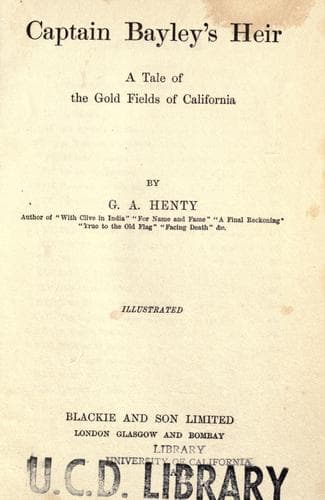
Captain Bayley's Heir: A Tale of the Gold Fields of CaliforniaHenty, G. A. (George Alfred)
General
Captain Bayley's Heir: A Tale of the Gold Fields of California
Henty, G. A. (George Alfred)
California -- Gold discoveries -- Juvenile fiction
The next evening the young man dropped his shovel as he approached him,
and came to meet him.
"I did not thank you last night," he began.
"Nonsense," Frank said, interrupting; "there is no occasion whatever for
thanks. Why, it's the custom here, whenever any one is taken ill, or is
unfortunate, and has to move on, a few friends, or, as it often happens,
a few strangers, will each chip in a pinch of gold dust to help him on.
It's the rule here that we stand by each other, and being both
Englishmen, it is natural we should lend each other a hand. How is your
mate?"
"He is a good deal better, thanks to the food I was able to get for him;
for, as you guessed, we have been nearly starving the last fortnight."
"But why did you keep on working at such a place as this?" Frank asked.
"Why didn't you go on wages? There are plenty of men here who would be
glad to take on an extra hand if they could get him."
The young man hesitated.
"I know it must seem utter folly," he said at last, "but the fact is my
partner has a fixed idea that claim will turn out well; he dreamt it."
"Pooh!" Frank said; "diggers are constantly dreaming about lucky
places--and no wonder, when they are always thinking about them. I
consider it madness to keep on toiling here, even if your mate is ill.
It is folly to give in to him in this way, and for you both to be
half-starved when you can earn, at any rate, enough to keep you both by
working for others."
"That is just what I knew you would say," the young man replied, "and I
feel it myself, thoroughly."
"Then why on earth do you keep on doing it?"
"I have a reason, a very particular reason, though I am not at liberty
to explain it."
"Well, then, there's no more to be said," Frank replied, vexed at what
he regarded as obstinate folly. He talked for a few minutes, and then
strolled away, and for the next two days did not go near the digger who
seemed so bent on slaving uselessly.
The third day Frank noticed that the man was not at work on his claim.
As soon as he knocked off in the evening he walked across to the spot.
The tools still lay in the hole, showing that the claim had not been
abandoned, although work had temporarily ceased.
Next day the claim was still unworked; the tent stood in its place,
showing that the diggers had not moved away. Although, from their
previous conversation, Frank thought that he might not improbably meet
with a repulse, after work was done he strolled over to the tent.
"Are you in, mate?" he asked, outside. "Seeing you were not at work for
the last two days, I thought I would walk over and ask you if anything
was the matter."
The young man came out from the tent; he looked utterly worn-out.
"My father has been too ill for me to leave him," he said, in a low
tone. "I spoke of him as my mate before, but he is my father."
"Can I do anything?" Frank asked.
Public-domain text, read in full here on John Shaqi.
Reviews
Reviews
No reviews yet
Be the first to share your thoughts on this work.
Elsewhere in the archive
Join the Discussion
Join the discussion
Sign in to leave a comment or review.
Sign InorCreate an account